


Page 44 - (DK Eyewitness) Travel Guide - Brittany
P. 44
42 INTRODUCING BRIT T AN Y
settlements, were Martis (Corseul), Conde vincum
agriculturalists who also (Nantes) and Darioritum (Vannes).
worked iron, minted coins While baths, amphithea tres
and engaged in overseas and villas marked the influence
trade. They were ruled by a warrior of Roman civilization, Celtic
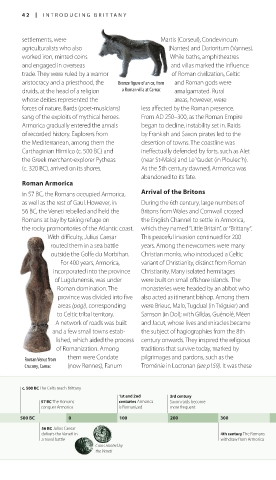
aristocracy and a priesthood, the Bronze figure of an ox, from and Roman gods were
druids, at the head of a religion a Roman villa at Carnac amalga mated. Rural
whose deities represented the areas, how ever, were
forces of nature. Bards (poet-musicians) less affected by the Roman presence.
sang of the exploits of mythical heroes. From AD 250–300, as the Roman Empire
Armorica gradu ally entered the annals began to decline, instability set in. Raids
of recorded history. Explorers from by Frankish and Saxon pirates led to the
the Mediterranean, among them the desertion of towns. The coastline was
Carthaginian Himilco (c. 500 BC) and ineffectually defended by forts, such as Alet
the Greek merchant-explorer Pytheas (near St-Malo) and Le Yaudet (in Ploulec’h).
(c. 320 BC), arrived on its shores. As the 5th century dawned, Armorica was
abandoned to its fate.
Roman Armorica
In 57 BC, the Romans occu pied Armorica, Arrival of the Britons
as well as the rest of Gaul. However, in During the 6th century, large numbers of
56 BC, the Veneti rebelled and held the Britons from Wales and Cornwall crossed
Romans at bay by taking refuge on the English Channel to settle in Armorica,
the rocky promontories of the Atlantic coast. which they named “Little Britain”, or “Brittany”.
With diffi culty, Julius Caesar This peaceful invasion continued for 200
routed them in a sea battle years. Among the newcomers were many
outside the Golfe du Morbihan. Christian monks, who introduced a Celtic
For 400 years, Armorica, variant of Christianity, distinct from Roman
incorporated into the province Christianity. Many iso lated hermitages
of Lugdunensis, was under were built on small offshore islands. The
Roman domi nation. The monasteries were headed by an abbot who
province was divided into five also acted as itinerant bishop. Among them
areas (pagi), corresponding were Brieuc, Malo, Tugdual (in Tréguier) and
to Celtic tribal territory. Samson (in Dol); with Gildas, Guénolé, Méen
A network of roads was built and Jacut, whose lives and miracles became
and a few small towns estab- the subject of hagiographies from the 8th
lished, which aided the process century onwards. They inspired the religious
of Romanization. Among traditions that survive today, marked by
them were Condate pilgrimages and pardons, such as the
Roman Venus from
Crucuny, Carnac (now Rennes), Fanum Troménie in Locronan (see p159). It was these
c. 500 BC The Celts reach Brittany
1st and 2nd 3rd century
57 BC The Romans centuries Armorica Saxon raids become
conquer Armorica is Romanized more frequent
500 BC 0 100 200 300 400
56 BC Julius Caesar
defeats the Veneti in 4th century The Romans
a naval battle withdraw from Armorica
Coins minted by
the Veneti
040-047_EW_Brittany.indd 42 11/3/16 1:02 PM

