


Page 45 - (DK Eyewitness) Travel Guide - Brittany
P. 45
THE HIST OR Y OF BRIT T AN Y 43
Several times, Brittany was invaded by the
Mero vingians. Their influence was short-
lived, however, and the Bretons kept their
independence – ruled by warlike local
chiefs or petty kings.
The powerful Carolingian dynasty could
do no more than establish a buffer zone,
the Marches, which extended from the
Baie du Mont-St-Michel to the Loire estuary.
From about 770, this was controlled by
Roland, “nephew” of Charlemagne. In the
9th century, the Bretons established an
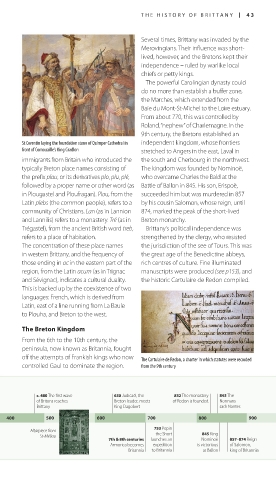
St Corentin laying the foundation stone of Quimper Cathedral in independent kingdom, whose frontiers
front of Cornouaille’s King Gradlon stretched to Angers in the east, Laval in
immigrants from Britain who introduced the the south and Cherbourg in the northwest.
typically Breton place names consisting of The kingdom was founded by Nominoë,
the prefix plou, or its derivatives plo, plu, plé, who overcame Charles the Bald at the
followed by a proper name or other word (as Battle of Ballon in 845. His son, Erispoë,
in Plougastel and Ploufragan). Plou, from the succeeded him but was murdered in 857
Latin plebs (the com mon people), refers to a by his cousin Salomon, whose reign, until
community of Christians. Lan (as in Lannion 874, marked the peak of the short-lived
and Lannilis) refers to a monastery. Tré (as in Breton monarchy.
Trégastel), from the ancient British word treb, Brittany’s political independence was
refers to a place of habita tion. strengthened by the clergy, who resisted
The concentration of these place names the jurisdiction of the see of Tours. This was
in western Brittany, and the frequency of the great age of the Benedictine abbeys,
those ending in ac in the eastern part of the rich centres of culture. Fine illuminated
region, from the Latin acum (as in Trignac manuscripts were produced (see p153), and
and Sévignac), indicates a cultural duality. the his toric Cartulaire de Redon compiled.
This is backed up by the coexistence of two
languages: French, which is derived from
Latin, east of a line run ning from La Baule
to Plouha, and Breton to the west.
The Breton Kingdom
From the 6th to the 10th century, the
peninsula, now known as Britannia, fought
off the attempts of Frankish kings who now The Cartulaire de Redon, a charter in which statutes were recorded
controlled Gaul to dominate the region. from the 9th century
c. 480 The first wave 630 Judicaël, the 832 The monastery 843 The
of Britons reaches Breton leader, meets of Redon is founded Normans
Brittany King Dagobert sack Nantes
400 500 600 700 800 900
753 Pepin
Altarpiece from
4th century The Romans St-Méliau the Short 845 King
withdraw from Armorica 7th & 8th centuries launches an Nominoë 857–874 Reign
Armorica becomes expedition is victorious of Salomon,
Britannia to Britannia at Ballon king of Britannia
040-047_EW_Brittany.indd 43 11/3/16 1:02 PM

