


Page 47 - (DK Eyewitness) Travel Guide - Brittany
P. 47
THE HIST OR Y OF BRIT T AN Y 45
Although tied to the king of France
through his vassal status, by the
13th century the count (then the duke)
of Brittany was in a sufficiently strong
position to move towards independence.
As Count of Richmond, in Yorkshire, he
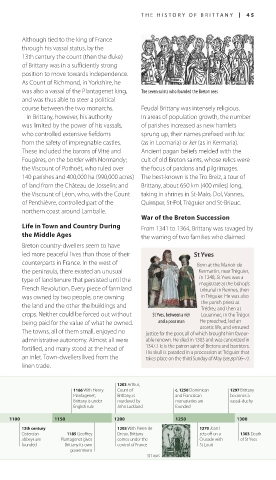
was also a vassal of the Plantagenet king, The seven saints who founded the Breton sees
and was thus able to steer a political
course between the two monarchs. Feudal Brittany was intensely reli gious.
In Brittany, however, his authority In areas of population growth, the number
was limited by the power of his vas sals, of parishes increased as new hamlets
who controlled extensive fief doms sprung up, their names prefixed with loc
from the safety of impregnable castles. (as in Locmaria) or ker (as in Kermaria).
These included the barons of Vitré and Ancient pagan beliefs melded with the
Fougères, on the border with Normandy; cult of old Breton saints, whose relics were
the Viscount of Porhoët, who ruled over the focus of pardons and pilgrimages.
140 parishes and 400,000 ha (990,000 acres) The best-known is the Tro Breiz, a tour of
of land from the Château de Josselin; and Brittany, about 650 km (400 miles) long,
the Viscount of Léon, who, with the Count taking in shrines in St-Malo, Dol, Vannes,
of Penthièvre, controlled part of the Quimper, St-Pol, Tréguier and St-Brieuc.
northern coast around Lamballe.
War of the Breton Succession
Life in Town and Country During From 1341 to 1364, Brittany was rav aged by
the Middle Ages the warring of two families who claimed
Breton country-dwellers seem to have
led more peaceful lives than those of their St Yves
counterparts in France. In the west of Born at the Manoir de
the peninsula, there existed an unusual Kermartin, near Tréguier,
type of land tenure that per sisted until the in 1248, St Yves was a
magis trate at the bishop’s
French Revolution. Every piece of farmland tribunal in Rennes, then
was owned by two people, one owning in Tréguier. He was also
the land and the other the buildings and the parish priest at
Trédrez and then at
crops. Neither could be forced out without St Yves, between a rich Louannec, in the Trégor.
being paid for the value of what he owned. and a poor man He preached, led an
ascetic life, and ensured
The towns, all of them small, enjoyed no justice for the poor, all of which brought him favour-
administrative autonomy. Almost all were able renown. He died in 1303 and was canon ized in
fortified, and many stood at the head of 1347. He is the patron saint of Bretons and barristers.
His skull is parad ed in a procession at Tréguier that
an inlet. Town-dwellers lived from the takes place on the third Sunday of May (see pp106–7).
linen trade.
1203 Arthur,
1166 With Henry Count of c. 1250 Dominican 1297 Brittany
Plantagenet, Brittany, is and Franciscan becomes a
Brittany is under murdered by monasteries are vassal-duchy
English rule John Lackland founded
1100 1150 1200 1250 1300
12th century 1203 With Pierre de 1270 Jean I
Cistercian 1185 Geoffrey Dreux, Brittany sets off on a 1303 Death
abbeys are Plantagenet gives comes under the Crusade with of St Yves
founded Brittany its own control of France St Louis
government
St Louis
040-047_EW_Brittany.indd 45 11/3/16 1:02 PM

