


Page 88 - (DK Eyewitness) Travel Guide - Brittany
P. 88
86 BRIT T AN Y REGION B Y REGION
Exploring St-Malo Garangeau
Throughout its history, this port city, sheltered from battering The civil and naval architect
winds by its ramparts, has maintained a fierce spirit of Siméon de Garangeau (1647–
independence. This is reflected in the motto “Foremost a 1741) had worked in Marseille
and in Brest before he took
native of St-Malo, a Breton perhaps, and a Frenchman last”. charge of building St-Malo’s
Its indomitable seamen have sailed the high seas in search of fortifications. The great military
undiscovered lands and of exotic goods that could be traded engineer Vauban considered
for a high return in Europe. Both privateers and shipowners that the coastal fort of La
Conchée, which Garangeau
made their fortunes here, and, in the 17th and 18th centuries, built, was the best building in
the kings of France as well as St-Malo itself also profited France. As a civil architect,
handsomely. The private residences and malouinières (grand Garangeau was also responsible
country residences) that can be seen today are proof of this for much of St-Malo’s unique
architectural character.
fabulous success.
An Eventful independent, albeit
History shortlived, republic in
As early as 1308, the defiance of Henri IV’s
inhabitants of St-Malo showed royal authority. By
their mettle by establishing the end of the 15th
the first free town in century, having grown
Brittany, and, in 1395, prosperous through
rebelling against the Duke trade and from fishing
of Brittany, they obtained off Newfoundland,
leave to answer only St-Malo had become a
to Charles VI, king of port of international
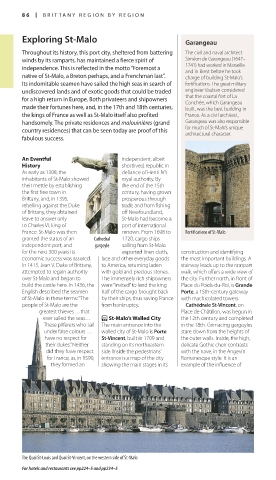
France. St-Malo was then renown. From 1698 to Fortifications of St-Malo
granted the status of an Cathedral 1720, cargo ships
independent port, and gargoyle sailing from St-Malo
for the next 300 years its exported linen cloth, construction and identifying
economic success was assured. lace and other everyday goods the most important buildings. A
In 1415, Jean V, Duke of Brittany, to America, returning laden stairway leads up to the rampart
attempted to regain authority with gold and precious stones. walk, which offers a wide view of
over St-Malo and began to The immensely rich shipowners the city. Further north, in front of
build the castle here. In 1436, the were “invited” to lend the king Place du Poids-du-Roi, is Grande
English described the seamen half of the cargo brought back Porte, a 15th-century gateway
of St-Malo in these terms: “The by their ships, thus saving France with machicolated towers.
people of St-Malo are the from bankruptcy. Cathédrale St-Vincent, on
greatest thieves …that Place de Châtillon, was begun in
ever sailed the seas… P St-Malo’s Walled City the 12th century and completed
These pilferers who sail The main entrance into the in the 18th. Grimacing gargoyles
under false colours … walled city of St-Malo is Porte stare down from the heights of
have no respect for St-Vincent, built in 1709 and the outer walls. Inside, the high,
their dukes.” Neither standing on its northeastern delicate Gothic choir contrasts
did they have respect side. Inside the pedestrians’ with the nave, in the Angevin
for France, as, in 1590, entrance is a map of the city Romanesque style. It is an
they formed an showing the main stages in its example of the influence of
The Quai St-Louis and Quai St-Vincent, on the western side of St-Malo
For hotels and restaurants see pp224–5 and pp234–5
086-087_EW_Brittany.indd 86 11/3/16 1:02 PM

