


Page 93 - (DK Eyewitness) Travel Guide - Brittany
P. 93
ILLE-E T-VILAINE 91
was before a small group of
British and Americans created
the fashion for com fortable
mansions in coastal resorts.
In 1873, the Lebanese arist-
ocrat Joseph Rochaïd Dahda
purchased land on which to
build. English-style manor
houses then appeared, along
with Louis XIII-style chateaux,
colonial houses and mock-
Breton villas. British and Euro-
pean aristocrats flocked to
Dinard’s palatial residences.
The attraction, albeit slightly
antiquated, is still alive today,
and the smart young set con-
tinues to come here. Walks in
either direction along the
coast pass ostentatious villas
typical of Dinard in its fashion-
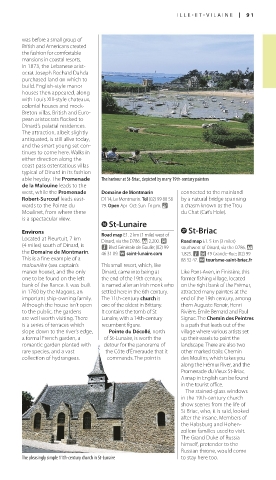
able heyday. The Promenade The harbour at St-Briac, depicted by many 19th-century painters
de la Malouine leads to the
west, while the Promenade Domaine de Montmarin connected to the mainland
Robert-Surcouf leads east- D114, Le Montmarin. Tel (02) 99 88 58 by a natural bridge span ning
wards to the Pointe du 79. Open Apr–Oct: Sun–Fri pm. & a chasm known as the Trou
Moulinet, from where there du Chat (Cat’s Hole).
is a spectacular view.
h St-Lunaire
Environs Road map E1. 2 km (1 mile) west of j St-Briac
Located at Pleurtuit, 7 km Dinard, via the D786. * 2,200. £ Road map E1. 5 km (3 miles)
(4 miles) south of Dinard, is n Blvd Générale de Gaulle; (02) 99 southwest of Dinard, via the D786. *
the Domaine de Montmarin. 46 31 09. ∑ saint-lunaire.com 1,825. n £ 49 Grande-Rue; (02) 99
This is a fine example of a 88 32 47. ∑ tourisme-saint-briac.fr
malounière (sea captain’s This small resort, which, like
manor house), and the only Dinard, came into being at Like Pont-Aven, in Finistère, this
one to be found on the left the end of the 19th century, former fishing village, located
bank of the Rance. It was built is named after an Irish monk who on the right bank of the Frémur,
in 1760 by the Magons, an settled here in the 6th century. attracted many painters at the
important ship-owning family. The 11th-century church is end of the 19th century, among
Although the house isn’t open one of the oldest in Brittany. them Auguste Renoir, Henri
to the public, the gardens It contains the tomb of St Rivière, Émile Bernard and Paul
are well worth visiting. There Lunaire, with a 14th- century Signac. The Chemin des Peintres
is a series of terraces which recumbent figure. is a path that leads out of the
slope down to the river’s edge, Pointe du Décollé, north village where various artists set
a formal French garden, a of St-Lunaire, is worth the up their easels to paint the
romantic garden planted with detour for the panorama of landscape. There are also two
rare species, and a vast the Côte d’Émeraude that it other marked trails: Chemin
collection of hydrangeas. commands. The point is des Moulins, which takes you
along the Frémur River, and the
Promenade du Vieux St-Briac.
A map in English can be found
in the tourist office.
The stained-glass windows
in the 19th-century church
show scenes from the life of
St Briac, who, it is said, looked
after the insane. Members of
the Habsburg and Hohen-
zollern families used to visit.
The Grand Duke of Russia
himself, pretender to the
Russian throne, would come
The pleasingly simple 11th-century church in St-Lunaire to stay here too.
090-091_EW_Brittany.indd 91 11/3/16 1:02 PM

