


Page 43 - BBC Wildlife Volume 36 #05
P. 43
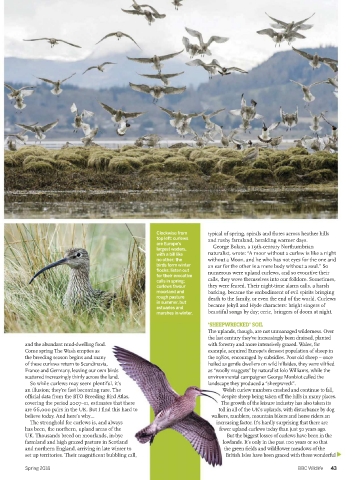
Clockwise from   typical of spring, spirals and flutes across heather hills
                                                      top left: curlews   and rushy farmland, heralding warmer days.
                                                      are Europe’s
                                                      largest waders,    George Bolam, a 19th-century Northumbrian
                                                      with a bill like   naturalist, wrote: “A moor without a curlew is like a night
                                                      no other; the    without a Moon, and he who has not eyes for the one and
                                                      birds form winter   an ear for the other is a mere body without a soul.” So
                                                      flocks; listen out   numerous were upland curlews, and so evocative their
                                                      for their evocative
                                                      calls in spring;   calls, they wove themselves into our folklore. Sometimes,
                                                      curlews favour   they were feared. Their night-time alarm calls, a harsh
                                                      moorland and     barking, became the embodiment of evil spirits bringing
                                                      rough pasture    death to the family, or even the end of the world. Curlews
                                                      in summer, but
                                                      estuaries and    became Jekyll and Hyde characters: bright singers of
                                                      marshes in winter.   beautiful songs by day; eerie, bringers of doom at night.
                                                                       ‘SHEEP
                                                                             WRE
                                                                                      SO
                                                                                 CKED’
                                                                       ‘SHEEPWRECKED’ SOIL
                                                                       The uplands, though, ar re not unmanaged wilderness. Over
                                                                                        i
                                                                       the last century they’ve  increasingly been drained, planted
          and the abundant mud-dwelling food.                          with forestry and more i intensively grazed. Wales, for
          Come spring The Wash empt ties as                            example, acquired Euro pe’s densest population of sheep in
          the breeding season begins an nd many                        the 1980s, encouraged b
                                                                                        by subsidies. Poor old sheep – once
          of these curlews return to Sca andinavia,                    hailed as gentle dwellers s on wild hillsides, they were vilified
          France and Germany, leaving g our own birds                  as “woolly maggots” by n
                                                                                        naturalist Iolo Williams, while the
          scattered increasingly thinly a across the land.             environmental campaig gner George Monbiot called the
           So while curlews may seem plentiful, it’s                   landscape they produced
                                                                                        d a “sheepwreck”.
          an illusion; they’re fast becoming rare. The                      Welsh curlew nu
                                                                                       umbers crashed and continue to fall,
                                                                                        ng taken off the hills in many places.
          official data from the BTO B Breeding Bird Atlas,                  despite sheep bein
          covering the period 2007–11 1, estimates that there               The growth of the e leisure industry has also taken its
                                                                                        K’s uplands, with disturbance by dog
          are 66,000 pairs in the UK. . But I find this hard to             toll in all of the UK
          believe today. And here’s wh hy…                               walkers, ramblers, mo ountain bikers and horse riders an
           The stronghold for curlew ws is, and always                    increasing factor. It’ s hardly surprising that there are
          has been, the northern, upla and areas of the                    fewer upland curle ews today than just 50 years ago.
          UK. Thousands breed on moorlands, in-bye                            But the biggest t losses of curlews have been in the
          farmland and high grazed pasture in Scotland                      lowlands. It’s onl ly in the past 100 years or so that
          and northern England, arriv ving in late winter to                 the green fields  and wildflower meadows of the
          set up territories. Their mag gnificent bubbling call,              British Isles hav ve been graced with these wonderful
          Spring 2018                                                                                 BBC Wildlife  43

