


Page 45 - BBC Wildlife Volume 36 #05
P. 45
CURLEWS


                                                                         CURLEW COUNTRY

                                                                         This inspiring project in Shropshire and the Welsh
                                                                         Marches is leading the way for curlew recovery in
                                                                         lowland farmland. It started work in 2015 and for two
                                                                         years monitored a total of 40 nests. Not one chick
                                                                         survived due to predation. Now the project is using
                                                                         electric fencing and predator control near nests, and
                                                                         is pioneering ‘head-starting’ – taking eggs from the
                                                                         wild to incubate in captivity and then replace just
                                                                         before hatching. (This is done under licence from
                                                                         Natural England.) In 2017, 10 chicks fledged. Find out
                                                                         more about the project at www.curlewcountry.org


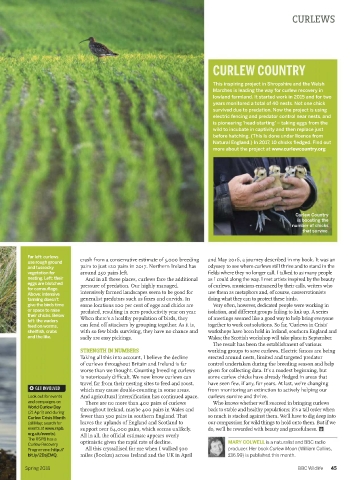
                                                                                                     Curlew Country
                                                                                                      is boosting the
                                                                                                    number of chicks
                                                                                                       that survive.


          Far left: curlews
          use rough ground   crash from a conservative estimate of 5,000 breeding  and May 2016, a journey described in my book. It was an
          and tussocky      pairs to just 120 pairs in 2017. Northern Ireland has  odyssey to see where curlews still thrive and to stand in the
          vegetation for    around 250 pairs left.                     fields where they no longer call. I talked to as many people
          nesting. Left: their   And in all these places, curlews face the additional  as I could along the way. I met artists inspired by the beauty
          eggs are blotched   pressure of predation. Our highly managed,  of curlews, musicians entranced by their calls, writers who
          for camouflage.
          Above: intensive   intensively farmed landscapes seem to be good for  use them as metaphors and, of course, conservationists
          farming doesn’t   generalist predators such as foxes and corvids. In  doing what they can to protect these birds.
          give the birds time   some locations 100 per cent of eggs and chicks are  Very often, however, dedicated people were working in
          or space to raise   predated, resulting in zero productivity year on year.  isolation, and different groups failing to link up. A series
          their chicks. Below
          left: the waders   When there’s a healthy population of birds, they  of meetings seemed like a good way to help bring everyone
          feed on worms,    can fend off attackers by grouping together. As it is,  together to work out solutions. So far, ‘Curlews in Crisis’
          shellfish, crabs   with so few birds surviving, they have no chance and  workshops have been held in Ireland, southern England and
          and the like.     sadly are easy pickings.                   Wales; the Scottish workshop will take place in September.
                                                                         The result has been the establishment of various
                            STRENGTH IN NUMBERS                        working groups to save curlews. Electric fences are being
                            Taking all this into account, I believe the decline  erected around nests, limited and targeted predator
                            of curlews throughout Britain and Ireland is far  control undertaken during the breeding season and help
                            worse than we thought. Counting breeding curlews  given for collecting data. It’s a modest beginning, but
                            is notoriously difficult. We now know curlews can  some curlew chicks have already fledged in areas that
                            travel far from their nesting sites to feed and roost,  have seen few, if any, for years. At last, we’re changing
           +  GET INVOLVED  which may cause double-counting in some areas.  from monitoring an extinction to actively helping our
          Look out for events  And agricultural intensification has continued apace.  curlews survive and thrive.
          and campaigns on    There are no more than 400 pairs of curlews  Who knows whether we’ll succeed in bringing curlews
          World Curlew Day  throughout Ireland, maybe 400 pairs in Wales and  back to stable and healthy populations; it’s a tall order when
          (21April) and during
          Curlew Crisis Month  fewer than 300 pairs in southern England. That  so much is stacked against them. We’ll have to dig deep into
          (all May; search for  leaves the uplands of England and Scotland to  our compassion for wild things to hold onto them. But if we
          events at www.rspb.  support over 64,000 pairs, which seems unlikely.   do, we’ll be rewarded with beauty and gracefulness.
          org.uk/events).   All in all, the official estimate appears overly
          The RSPB has a
          Curlew Recovery   optimistic given the rapid rate of decline.       MARY COLWELL is a naturalist and BBC radio
          Programme: http://  All this crystallised for me when I walked 500  producer. Her book Curlew Moon (William Collins,
          bit.ly/2DsjEMQ.   miles (800km) across Ireland and the UK in April  £16.99) is published this month.
          Spring 2018                                                                                 BBC Wildlife  45

