


Page 44 - BBC Wildlife Volume 36 #05
P. 44
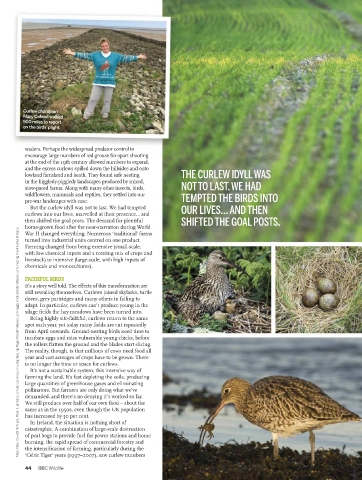
Curlew champion
         Mary Colwell walked
         500 miles to report
         on the birds’ plight.


          waders. Perhaps the widespread predator control to
          encourage large numbers of red grouse for sport shooting
          at the end of the 19th century allowed numbers to expand,
          and the excess curlews spilled down the hillsides and onto
          lowland farmland and heath. They found safe nesting  THE CURLEW IDYLL WAS
          in the higgledy-piggledy landscapes produced by mixed,
          slow-paced farms. Along with many other insects, birds,  NOT TO LAST. WE HAD
          wildflowers, mammals and reptiles, they settled into our
          pre-war landscapes with ease.                       TEMPTED THE BIRDS INTO
           But the curlew idyll was not to last. We had tempted  OUR LIVES… AND THEN
          curlews into our lives, marvelled at their presence… and
          then shifted the goal posts. The demand for plentiful  SHIFTED THE GOAL POSTS.
          home-grown food after the near-starvation during World
       ja/Getty; chicks: curlewcountry.org; feed ng: Roger Powell/naturepl.com; eggs: Andy Sands/naturepl.com; nest ng: Mark Hamblin/Getty
          War II changed everything. Numerous ‘traditional’ farms
          turned into industrial units centred on one product.
          Farming changed from being extensive (small-scale,
          with low chemical inputs and a rotating mix of crops and
          livestock) to intensive (large-scale, with high inputs of
          chemicals and monocultures).
          FAITHFUL BIRDS
          It’s a story well told. The effects of this transformation are
          still revealing themselves. Curlews joined skylarks, turtle
          doves, grey partridges and many others in failing to
          adapt. In particular, curlews can’t produce young in the
          silage fields the hay meadows have been turned into.
           Being highly site-faithful, curlews return to the same
          spot each year, yet today many fields are cut repeatedly
          from April onwards. Ground-nesting birds need time to
          incubate eggs and raise vulnerable young chicks, before
          the rollers flatten the ground and the blades start slicing.
          The reality, though, is that millions of cows need food all
          year and vast acreages of crops have to be grown. There
          is no longer the time or space for curlews.
           It’s not a sustainable system, this intensive way of
          farming the land. It’s fast depleting the soils, producing
          large quantities of greenhouse gases and eliminating
          pollinators. But farmers are only doing what we’ve
          demanded, and there’s no denying it’s worked so far.
          We still produce over half of our own food – about the
       Mary: Mary Colwell; farmland: Peter L  catastrophic. A combination of large-scale destruction
          same as in the 1950s, even though the UK population
          has increased by 50 per cent.
           In Ireland, the situation is nothing short of

          of peat bogs to provide fuel for power stations and home
          burning, the rapid spread of commercial forestry and
          the intensification of farming, particularly during the
          ‘Celtic Tiger’ years (1997–2007), saw curlew numbers
          44  BBC Wildlife

