


Page 51 - BBC Wildlife Volume 36 #05
P. 51
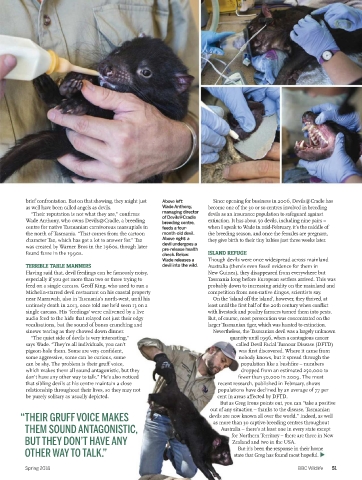
brief confrontation. But on that showing, they might just  Above left:   Since opening for business in 2006, Devils@Cradle has
          as well have been called angels as devils.    Wade Anthony,   become one of the 30 or so centres involved in breeding
                                                        managing director
           “Their reputation is not what they are,” confirms            devils as an insurance population to safeguard against
                                                        of Devils@Cradle
          Wade Anthony, who owns Devils@Cradle, a breeding             extinction. It has about 50 devils, including nine pairs –
                                                        breeding centre,
          centre for native Tasmanian carnivorous marsupials in  feeds a four-   when I speak to Wade in mid-February, it’s the middle of
          the north of Tasmania. “That comes from the cartoon  month-old devil.   the breeding season, and once the females are pregnant,
          character Taz, which has got a lot to answer for.” Taz  Above right: a   they give birth to their tiny babies just three weeks later.
                                                        devil undergoes a
          was created by Warner Bros in the 1960s, though later
                                                        pre-release health
          found fame in the 1990s.                      check. Below:   ISLAND REFUGE
                                                        Wade releases a   Though devils were once widespread across mainland
          TERRIBLE TABLE MANNERS                        devil into the wild.  Australia (there’s even fossil evidence for them in
          Having said that, devil feedings can be famously noisy,      New Guinea), they disappeared from everywhere but
          especially if you get more than two or three trying to       Tasmania long before European settlers arrived. This was
          feed on a single carcass. Geoff King, who used to run a      probably down to increasing aridity on the mainland and
          Michelin-starred devil restaurant on his coastal property    competition from non-native dingos, scientists say.
                                            t, until his
                                                                         On the ‘island off the island’, however, they thrived, at
          near Marrawah, also in Tasmania’s north-west until his         On the island off the is
          untimely death in 2013, once told me he’d see en 13 on a     least until the first half of f the 20th century when conflict
          single carcass. His ‘feedings’ were enlivened b by a live    with livestock and poultry
                                                                                         y farmers turned them into pests.
          audio feed to the hide that relayed not just the eir edgy    But, of course, most perse ecution was concentrated on the
                                                                                        which was hunted to extinction.
          vocalisations, but the sound of bones crunching and          larger Tasmanian tiger, w
                                                                                        manian devil was a largely unknown
          sinews tearing as they chowed down dinner.                     Nevertheless, the Tasm
           “The quiet side of devils is very interesting,”                     quantity until 1 996, when a contagious cancer
          says Wade. “They’re all individuals, you can’t                         called Devil l Facial Tumour Disease (DFTD)
          pigeon-hole them. Some are very confident,                               was first d iscovered. Where it came from
                                                                                         nows, but it spread through the
          some aggressive, some can be curious, some                              nobody kn
          can be shy. The problem is their gruff voice,                            populatio
                                                                                         on like a bushfire – numbers
          which makes them all sound antagonistic, bu ut they                      dropped f from an estimated 250,000 to
          don’t have any other way to talk.” He’s also no oticed                  fewer than
                                                                                         n 50,000 in 2009. The most
                                                                                         blished in February, shows
          that sibling devils at his centre maintain a close               recent research, pub
          relationship throughout their lives, so they may not             populations have de eclined by an average of 77 per
          be purely solitary as usually depicted.                          cent in areas affecte d by DFTD.
                                                                           But as Greg Irons p
                                                                                         points out, you can “take a positive
                                                                                         hanks to the disease, Tasmanian
                                                                        out of any situation – th
        “THEIR GRUFFVOICE MAKES                                         devils are now known al l over the world.” Indeed, as well
                                           S
                                                                         as more than 30 captiv ve-breeding centres throughout
         THEM SOUNDANTAGONISTTIC,                                           Australia – there’s  at least one in every state except
                                                                               for Northern T
                                                                                         Territory – there are three in New
                                          Y
         BUTTHEYDON’THAVEANY                                                    Zealand and t two in the USA.
                                                                                 But it’s bee
                                                                                         n the response in their home
         OTHERWAYTOTALK.”                                                       state that Gre eg has found most hopeful.
          Spring 2018                                                                                 BBC Wildlife  51

