


Page 52 - BBC Wildlife Volume 36 #05
P. 52
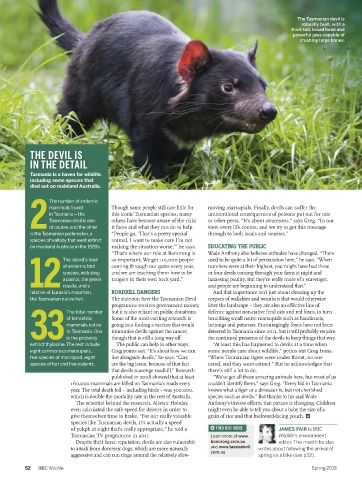
The Tasmanian devil is
                                                                                                       robustly built, with a
                                                                                                    thick tail, broad head and
                                                                                                    powerful jaws capable of
                                                                                                      crushing large bones.


           THE DEVIL IS
           IN THE DETAIL
           Tasmania is a haven for wildlife,
           including some species that
           died out on mainland Australia.

                  The number of endemic
                  mammals found        Though some people still care little for  moving marsupials. Finally, devils can suffer the
                  in Tasmania – the    this iconic Tasmanian species, many  unintentional consequences of poisons put out for rats
                  Tasmanian devil is one,   others have become aware of the risks  or other pests. “It’s about awareness,” says Greg. “In our
           2 of course, and the other   it faces and what they can do to help.  view, every life counts, and we try to get this message
           is the Tasmanian pademelon, a   “People go, ‘That’s a pretty special  through to both locals and tourists.”
           species of wallaby that went extinct   animal, I want to make sure I’m not
           on mainland Australia in the 1920s.  making the situation worse,’” he says.  EDUCATING THE PUBLIC
                                       “That’s where our role at Bonorong is  Wade Anthony also believes attitudes have changed. “There
                      The island’s haul   so important. We get 110,000 people  used to be quite a bit of persecution here,” he says. “When
                      of endemic bird   coming through our gates every year,  numbers were at their highest, you might have had three
                      species, including   and we are teaching them how to be  or four devils coming through your farm at night and
                      a parrot, the green   rangers in their own back yard.”  harassing poultry. But they’re really more of a scavenger,
           12 rosella, and a                                           and people are beginning to understand that.”
           relative of Eurasia’s moorhen,   ROADKILL DANGERS             And that importance isn’t just about cleaning up the
           the Tasmanian native hen.   The state-run Save the Tasmanian Devil  corpses of wallabies and wombats that would otherwise
                                       programme receives government money,  litter the landscape – they are also an effective line of
                        The total number   but it is also reliant on public donations.  defence against non-native feral cats and red foxes, in turn
                        of terrestrial   Some of the most exciting research is  benefiting small native marsupials such as bandicoots,
                        mammals native   going into finding a vaccine that would  bettongs and potoroos. Encouragingly, foxes have not been
                        to Tasmania. One   immunise devils against the cancer,  detected in Tasmania since 2011, but it will probably require
           33 is the probably          though that is still a long way off.  the continued presence of the devils to keep things that way.
           extinct thylacine. The rest include   The public can help in other ways,  “At least this has happened to devils at a time when
           eight carnivorous marsupials,   Greg points out. “It’s about how we can  some people care about wildlife,” points out Greg Irons.
           five species of macropod, eight   live alongside devils,” he says. “Cars  “When Tasmanian tigers were under threat, no one
           species of bat and five rodents.  are the big issue, because of that fact  cared, and they went extinct.” But he acknowledges that
                                       that devils scavenge roadkill.” Research  there’s still a lot to do.
                                       published in 2008 showed that at least  “We’ve got all these amazing animals here, but most of us
                         160,000 mammals are killed on Tasmania’s roads every  couldn’t identify them,” says Greg. “Every kid in Tasmania
                         year. The total death toll – including birds – was 300,000,  knows what a tiger or a dinosaur is, but not cherished
                         which is double the mortality rate in the rest of Australia.  species such as devils.” But thanks to his and Wade
                           The scientist behind the research, Alistair Hobday,  Anthony’s tireless efforts, that picture is changing. Children
                         even calculated the safe speed for drivers in order to  might even be able to tell you about a baby the size of a
                         give themselves time to brake. “For our really valuable  grain of rice and that backward-facing pouch.
                         species like Tasmanian devils, it’s actually a speed
                         of 50kph at night that’s really appropriate,” he told a  + FIND OUT MORE  JAMES FAIR is BBC
                         Tasmanian TV programme in 2011.                Learn more at www.     Wildlife’s environment
                           Despite their fierce reputation, devils are also vulnerable  bonorong.com.au  editor. This month he also
                         to attack from domestic dogs, which are more naturally  and www.tassiedevil.  writes about following the arrival of
                                                                        com.au
                         aggressive and can run rings around the relatively slow-       spring on a bike (see p32).
          52  BBC Wildlife                                                                                Spring 2018

