


Page 71 - BBC Wildlife Volume 36 #05
P. 71
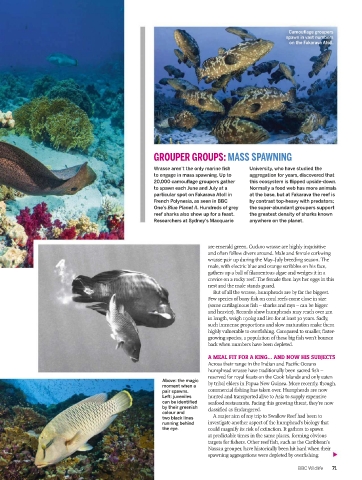
Camouflage groupers
                                                                                                  spawn in vast numbers
                                                                                                   on the Fakarava Atoll.


                                                     GROUPER GROUPS: MASS SPAWNING

                                                     Wrasse aren’t the only marine fish  University, who have studied the
                                                     to engage in mass spawning. Up to  aggregation for years, discovered that
                                                     20,000 camouflage groupers gather   this ecosystem is flipped upside-down.
                                                     to spawn each June and July at a  Normally a food web has more animals
                                                     particular spot on Fakarava Atoll in  at the base, but at Fakarava the reef is
                                                     French Polynesia, as seen in BBC  by contrast top-heavy with predators;
                                                     One’s Blue Planet II. Hundreds of grey  the super-abundant groupers support
                                                     reef sharks also show up for a feast.  the greatest density of sharks known
                                                     Researchers at Sydney’s Macquarie   anywhere on the planet.


                                                                       are emerald green. Cuckoo wrasse are highly inquisitive
                                                                       and often follow divers around. Male and female corkwing
                                                                       wrasse pair up during the May–July breeding season. The
                                                                       male, with electric blue and orange scribbles on his face,
                                                                       gathers up a ball of filamentous algae and wedges it in a
                                                                       crevice on a rocky reef. The female then lays her eggs in this
                                                                       nest and the male stands guard.
                                                                         But of all the wrasse, humpheads are by far the biggest.
                                                                       Few species of bony fish on coral reefs come close in size
                                                                       (some cartilaginous fish – sharks and rays – can be bigger
                                                                       and heavier). Records show humpheads may reach over 2m
                                                                       in length, weigh 190kg and live for at least 30 years. Sadly,
                                                                       such immense proportions and slow maturation make them
                                                                       highly vulnerable to overfishing. Compared to smaller, faster-
                                                                       growing species, a population of these big fish won’t bounce
                                                                       back when numbers have been depleted.

                                                                       A MEAL FIT FOR A KING… AND NOW HIS SUBJECTS
                                                                       Across their range in the Indian and Pacific Oceans
                                                                       humphead wrasse have traditionally been sacred fish –
                                                                       reserved for royal feasts on the Cook Islands and only eaten
                                                        Above: the magic
                                                        moment when a  by tribal elders in Papua New Guinea. More recently, though,
                                                        pair spawns.   commercial fishing has taken over. Humpheads are now
                                                        Left: juveniles  hunted and transported alive to Asia to supply expensive
                                                        can be identified  seafood restaurants. Facing this growing threat, they’re now
                                                        by their greenish  classified as Endangered.
                                                        colour and
                                                        two black lines  A major aim of my trip to Swallow Reef had been to
                                                        running behind   investigate another aspect of the humphead’s biology that
                                                        the eye.       could magnify its risk of extinction. It gathers to spawn
                                                                       at predictable times in the same places, forming obvious
                                                                       targets for fishers. Other reef fish, such as the Caribbean’s
                                                                       Nassau grouper, have historically been hit hard when their
                                                                       spawning aggregations were depleted by overfishing.
                                                                                                      BBC Wildlife  71

