


Page 73 - BBC Wildlife Volume 36 #05
P. 73
HUMPHEAD WRASSE


          But mass spawning is much better known in groupers than
          in humphead wrasse – the behaviour has only been seen in
          these giants at a handful of sites.
          UNIQUE AND UNDER THREAT
          It was imperative to work out how vulnerable wrasse are
          while they’re spawning, and hence how important it is
          to protect their spawning sites. To do that I spent weeks
          shooting hours of underwater footage of the spawning fish,
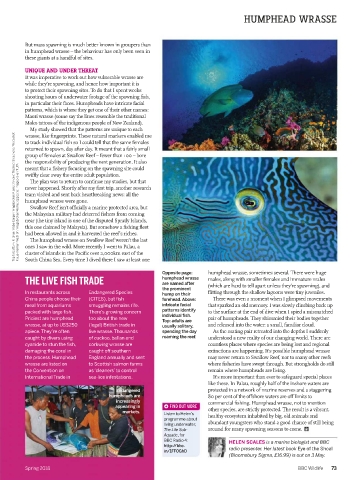
          in particular their faces. Humpheads have intricate facial
          patterns, which is where they get one of their other names:
          Maori wrasse (some say the lines resemble the traditional
          Moko tattoos of the indigenous people of New Zealand).
           My study showed that the patterns are unique to each
      Weberberger/ magebroker/A amy; V ncent Truchet/B osphoto/Photoshot; Klaus-Werner Friedrich/imagebroker/Alamy; opposite: Imagebroker/FLPA  group of females at Swallow Reef – fewer than 100 – bore
          wrasse, like fingerprints. These natural markers enabled me
          to track individual fish so I could tell that the same females
          returned to spawn, day after day. It meant that a fairly small

          the responsibility of producing the next generation. It also
          meant that a fishery focusing on the spawning site could
          swiftly clear away the entire adult population.
           The plan was to return to continue my studies, but that
          never happened. Shortly after my first trip, another research
          team visited and sent back heartbreaking news: all the
          humphead wrasse were gone.
           Swallow Reef isn’t officially a marine protected area, but
          the Malaysian military had deterred fishers from coming

          this one claimed by Malaysia). But somehow a fishing fleet
          had been allowed in and it harvested the reef’s riches.
      Top to bottom: M chae  near (the tiny island is one of the disputed Spratly Islands,
           The humphead wrasse on Swallow Reef weren’t the last
          ones I saw in the wild. More recently I went to Palau, a
          cluster of islands in the Pacific over 2,000km east of the
          South China Sea. Every time I dived there I saw at least one

                                                        Opposite page:  humphead wrasse, sometimes several. There were huge
          THE LIVE FISH TRADE                           humphead wrasse  males, along with smaller females and immature males
                                                        are named after
                                                        the prominent  (which are hard to tell apart unless they’re spawning), and
          In restaurants across   Endangered Species    hump on their  flitting through the shallow lagoons were tiny juveniles.
          China people choose their   (CITES), but fish   forehead.Above:  There was even a moment when I glimpsed movements
          meal from aquariums   smuggling remains rife.   intricate facial  that sparked an old memory. I was slowly climbing back up
          packed with large fish.   There’s growing concern   patterns identify  to the surface at the end of dive when I spied a mismatched
                                                        individual fish.
          Priciest are humphead   too about the new                    pair of humpheads. They shimmied their bodies together
                                                        Top: adults are
          wrasse, at up to US$250   (legal) British trade in   usually solitary,  and released into the water: a small, familiar cloud.
          apiece. They’re often   live wrasse. Thousands   spending the day  As the mating pair retreated into the depths I suddenly
          caught by divers using   of cuckoo, ballan and   roaming the reef.   understood a new reality of our changing world. There are
          cyanide to stun the fish,   corkwing wrasse are               countless places where species are being lost and regional
          damaging the coral in   caught of southern                   extinctions are happening. It’s possible humphead wrasse
          the process. Humphead   England annually and sent            may never return to Swallow Reef, nor to many other reefs
          wrasse are listed on   to Scottish salmon farms              where fisheries have swept through. But strongholds do still
          the Convention on    as ‘cleaners’ to control                remain where humpheads are living.
          International Trade in   sea-lice infestations.                It’s more important than ever to safeguard special places
                                                                       like these. In Palau, roughly half of the inshore waters are
                                        Endangered                     protected in a network of marine reserves and a staggering
                                      humpheads are                    80 per cent of the offshore waters are off limits to
                                        increasingly                   commercial fishing. Humphead wrasse, not to mention
                                        appearing in    +  FIND OUT MORE
                                           markets.     Listen to Helen’s  other species, are strictly protected. The result is a vibrant,
                                                        programme about  healthy ecosystem inhabited by big, old animals and
                                                        living underwater,  abundant youngsters who stand a good chance of still being
                                                        The Life Sub-  around for many spawning seasons to come.
                                                        Aquatic, for
                                                        BBC Radio 4:          HELEN SCALES is a marine biologist and BBC
                                                        http://bbc.
                                                        in/1FF0GhD            radio presenter. Her latest book Eye of the Shoal
                                                                              (Bloomsbury Sigma, £16.99) is out on 3 May.
          Spring 2018                                                                                 BBC Wildlife  73

