


Page 76 - BBC Wildlife Volume 36 #05
P. 76
ROTHSCHILD’S

          SPECIES


          Not only was Rothschild well-
          regarded as a zoologist, he
          also helped to fund scientific
          expeditions, so it’s hardly
          surprising that dozens of
          species were named in his
          honour. Many are butterflies,
          beetles and birds, reflecting his
          main passions. A total of 153
          insects, 58 birds, 18 mammals,
          three fish, three spiders, two
          reptiles, a millipede and a worm
          carry his name. Showy examples
          include Rothschild’s birdwing
          butterfly of New Guinea, a
          subspecies of giraffe and the
          spectacular Rothschild’s Atlas
          moth from South America.

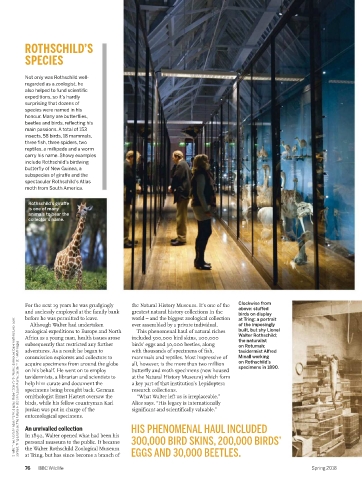
           Rothschild’s giraffe
           is one of many
           animals to bear the
           collector’s name.


          For the next 19 years he was grudgingly  the Natural History Museum. It’s one of the  Clockwise from
                                                                                  above: stuffed
          and uselessly employed at the family bank  greatest natural history collections in the
                                                                                  birds on display
          before he was permitted to leave.   world – and the biggest zoological collection  at Tring; a portrait
           Although Walter had undertaken     ever assembled by a private individual.  of the imposingly
          zoological expeditions to Europe and North  This phenomenal haul of natural riches  built, but shy Lionel
                                                                                  Walter Rothschild;
          Africa as a young man, health issues arose  included 300,000 bird skins, 200,000  the naturalist
       H story Museum/A amy; tax derm st: NHM Images; G rafe: Theo Allofs/Minden/FLPA; display: Robert Stainforth/Alamy; dormouse: Dave Watt/naturepl.com;   commission explorers and collectors to  mammals and reptiles. Most impressive of  Minall working
          subsequently that restricted any further
                                              birds’ eggs and 30,000 beetles, along
                                                                                  on Rotumah;
          adventures. As a result he began to
                                              with thousands of specimens of fish,
                                                                                  taxidermist Alfred
                                                                                  on Rothschild’s
          acquire specimens from around the globe
                                              all, however, is the more than two million
                                                                                  specimens in 1890.
                                              butterfly and moth specimens (now housed
          on his behalf. He went on to employ
          taxidermists, a librarian and scientists to
                                              at the Natural History Museum) which form
                                              a key part of that institution’s Lepidoptera
          help him curate and document the
                                              research collections.
          specimens being brought back. German
                                               “What Walter left us is irreplaceable,”
          ornithologist Ernst Hartert oversaw the
                                              Alice says. “His legacy is internationally
          birds, while his fellow countryman Karl
                                              significant and scientifically valuable.”
       portra t, Tr ng & torto se: The Natura  Jordan was put in charge of the  HIS PHENOMENAL HAUL INCLUDED
          entomological specimens.
          An unrivalled collection
          In 1892, Walter opened what had been his
                                             300,000 BIRD SKINS, 200,000 BIRDS’
          personal museum to the public. It became
          the Walter Rothschild Zoological Museum
          at Tring, but has since become a branch of  EGGS AND 30,000 BEETLES.
          76  BBC Wildlife                                                                                Spring 2018

