


Page 19 - History of War - Issue 01-14
P. 19
“The best-equipped British army that ever went forth to war…”


               Following the Boer War, Richard Burdon Haldane –   Edmonds later describing it as “incomparably, the best-   Another British Expeditionary Force was deployed at
               British Secretary of State for War – created the British   trained, best-organised and best-equipped British army   the start of the Second World War, under the command
               Expeditionary Force (BEF) in the event of a war on foreign   that ever went forth to war” (a stark contrast to Kaiser   of General Lord Gort. However, it was forced to evacuate
               soil. That event occurred in August 1914, with the start   Bill’s description of it as a “contemptible little army”).  from France in June 1940 as part of Operation Ariel.
               of the First World War. By that time, the BEF comprised
               a general HQ, three Army corps – each of two infantry
               divisions – a large cavalry division of four brigades and
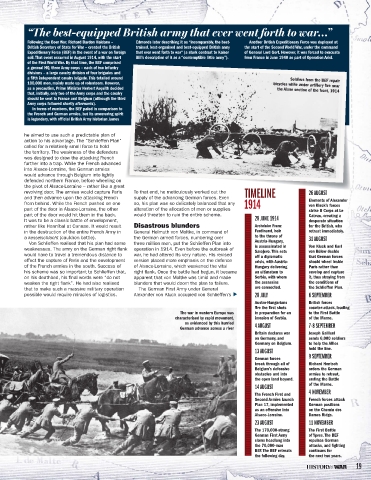
               a fifth independent cavalry brigade. This totalled around                                     Soldiers from the BEF repair

               100,000 men, mainly made up of volunteers. However,                                    bicycles while under artillery fi  re near
               as a precaution, Prime Minister Herbert Asquith decided                                 the Aisne section of the front, 1914
               that, initially, only two of the Army corps and the cavalry
               should be sent to France and Belgium (although the third
               Army corps followed shortly afterwards).
                 In terms of numbers, the BEF paled in comparison to
               the French and German armies, but its unwavering spirit
               is legendary, with official British Army historian James


              he aimed to use such a predictable plan of
              action to his advantage. The “Schlieffen Plan”
              called for a relatively small force to hold
              the territory. The weakness of the defenders
              was designed to draw the attacking French
              further into a trap. While the French advanced
              into Alsace-Lorraine, fi ve German armies
              would advance through Belgium into lightly
              defended northern France, before wheeling on
              the pivot of Alsace-Lorraine – rather like a great
              revolving door. The armies would capture Paris   To that end, he meticulously worked out the   TIMELINE  26 AUGUST
              and then advance upon the attacking French   supply of the advancing German forces. Even            Elements of Alexander
              from behind. While the French pushed on one   so, his plan was so delicately balanced that any   1914  von Kluck’s forces
              part of the door in Alsace-Lorraine, the other   alteration of the allocation of men or supplies    strike II Corps at Le
              part of the door would hit them in the back.   would threaten to ruin the entire scheme.            Cateau, creating a
              It was to be a classic battle of envelopment,                                    28 JUNE 1914       desperate situation
              rather like Hannibal at Cannae. It would result   Disastrous blunders            Archduke Franz     for the British, who
              in the destruction of the entire French Army in   General Helmuth von Moltke, in command of   Ferdinand, heir   retreat immediately.
              a kesselschlacht (cauldron battle).    the German armed forces, numbering over   to the throne of   31 AUGUST
                Von Schlieffen realised that his plan had some   three million men, put the Schlieffen Plan into   Austria-Hungary,
              weaknesses. The army on the German right fl ank   operation in 1914. Even before the outbreak of   is assassinated in   Von Kluck and Karl
                                                                                               Sarajevo. This sets
                                                                                                                  von Bülow decide
              would have to travel a tremendous distance to   war, he had altered its very nature. His revised   off a diplomatic   that German forces
              effect the capture of Paris and the envelopment   version placed more emphasis on the defence   crisis, with Austria-  should wheel inside
              of the French armies in the south. Success of   of Alsace-Lorraine, which weakened the vital   Hungary delivering   Paris rather than
              his scheme was so important to Schlieffen that,   right fl ank. Once the battle had begun, it became   an ultimatum to   envelop and capture
              on his deathbed, his fi nal words were “do not   apparent that von Moltke was timid and made   Serbia, with whom   it, thus straying from
              weaken the right fl ank”. He had also realised   blunders that would doom the plan to failure.  the assassins   the conditions of
              that to make such a massive military operation   The German First Army under General   are connected.   the Schlieffen Plan.
              possible would require miracles of logistics.   Alexander von Kluck occupied von Schlieffen’s   28 JULY  6 SEPTEMBER
                                                                                               Austro-Hungarians   British forces
                                                                                               fire the first shots   counter-attack, leading


                                                                     The war in western Europe was   in preparation for an   to the First Battle
                                                                   characterised by rapid movement,   invasion of Serbia.  of the Marne.
                                                                       as evidenced by this hurried   4 AUGUST    7-8 SEPTEMBER
                                                                     German advance across a river
                                                                                               Britain declares war   Joseph Gallieni
                                                                                               on Germany, and    sends 6,000 soldiers
                                                                                               Germany on Belgium.  to help the Allies
                                                                                               13 AUGUST          hold the line.
                                                                                               German forces      9 SEPTEMBER
                                                                                               break through all of   Richard Hentsch
                                                                                               Belgium’s defensive   orders the German
                                                                                               obstacles and into   armies to retreat,
                                                                                               the open land beyond.  ending the Battle
                                                                                               14 AUGUST          of the Marne.
                                                                                               The French First and   4 NOVEMBER
                                                                                               Second Armies launch   French forces attack
                                                                                               Plan 17, implemented   German positions
                                                                                               as an offensive into   on the Chemin des
                                                                                               Alsace-Lorraine.   Dames Ridge.
                                                                                               23 AUGUST          11 NOVEMBER
                                                                                               The 170,000-strong   The First Battle
                                                                                               German First Army   of Ypres. The BEF
                                                                                               slams headlong into   repulses German
                                                                                               the 70,000-man     attacks, and fighting

                                                                                               BEF. The BEF retreats   continues for
                                                                                               the following day.  the next two years.

                                                                                                                 HISTORY  WAR          19  19
                                                                                                                         Y
                                                                                                                 H
                                                                                                                   ISTO
                                                                                                                       R
                                                                                                                              R
                                                                                                                           WA
                                                                                                                          of of
        HoW01.Germany strikes west.indd   19                                                                                 29/01/2014   18:17

