


Page 24 - History of War - Issue 01-14
P. 24
THE SCHLIEFFEN PLAN

               Christmas truce                                                                         which would be the scene of desperate
                                                                                                         The shattered Belgian city of Ypres,
                                                                                                           fighting throughout World War I.

               As Christmas approached on the British sector of the
               Western Front, the weather turned clear and cold.
               Huddled in their trenches, the combatants – British
               and German alike – readied themselves for their

               first Christmas in the trenches. Late at night on 24
               December 1914, lit Christmas trees began to appear
               in the German trenches. Men on both sides began
               to sing Christmas carols, and were stunned to find

               their enemies – dug in only a short distance away
               – joining in to sing the familiar songs.

                 When morning came, nobody fired, lending the dawn
               an eerie calm. Men from both sides began to emerge   General Joffre assesses his French
               from their trenches – under flags of truce – and made   troops. His confidence and calmness


               their way across no-man’s land to meet the enemy.   were instrumental in the Allies’
               All across the line, fraternisation broke out among   victory at the Battle of the Marne
               men who had recently been trying desperately to kill
               one another. Germans and British soldiers shook hands,
               exchanged gifts, sang more songs, played football,   The situation for the Germans was becoming   Germany was now doomed to fi ght a two-front
               took photographs and buried the dead. One British   desperate. Von Moltke, out of touch and losing   war of attrition. The Battle of the Marne was
               soldier remembers his experience:     his nerve in his HQ in Luxembourg, had no   not decisive in the most conventional sense, for
                 “A German NCO with the Iron Cross started his   true idea of the developing situation or how   the Germans were not defeated or even driven
               fellows off on some marching tune. When they had done,   to control it. As a result, the Commander sent   from French soil. In some ways, though, it was
               I set the note for The Boys Of Bonnie Scotland, Where   Richard Hentsch, a mere Colonel, to take control   one of the most decisive battles in history.
               The Heather And The Bluebells Grow, and so we went   of the situation on the front. Hentsch, struggling   It forced Germany to fi ght a war that they could
               on, singing everything from Good King Wenceslas down
               to the ordinary Tommies’ songs, and ending up with   to fulfi l his task, met with both von Bülow   not win; a war that would soon settle down into
               Auld Lang Syne, which we all – English, Scots, Irish,   and von Kluck, and found that only von Kluck   a siege that ran the entire length of France.
               Prussian, Württembergers – joined in. It was absolutely   retained any confi dence in victory at the Marne.
               astounding and if I had seen it on a cinematograph film,   On 9 September, after the discussions closed,   Savage battles

               I should have sworn that it was faked!”  Hentsch made the most important decision   Kaiser Wilhelm replaced von Moltke with General
                  In some areas of the front, the Christmas truce   of his life and ordered the German armies to   Erich von Falkenhayn. The new Commander
               never took hold, but in many areas it lasted for up to   retreat. The Battle of the Marne was over.  noticed, as did Joffre, that there remained to the

               three days. It ended only when astounded Officers   The Schlieffen Plan had failed, partly due   north of the combatant forces an open fl ank –
               heard what was happening and ordered their men to   to von Moltke’s ineptitude and partly thanks to   and the possibility of victory. Even as German
               recommence hostilities. Often, the firing began again

               only after warnings and apologies had been issued to   Joffre’s steady hand. Though many historians   forces near Paris fell back to the Aisne River,
               the enemy. In the end, the Christmas truce did not hold   contend that it was doomed to failure from its   von Falkenhayn began quickly to remove troops
               and would not be repeated as the ferocity of the war   inception, von Moltke had contributed to its   from Alsace-Lorraine in an effort to outfl ank the
               grew apace. But for one brief, beautiful moment, the   fi nal ruination by steadily weakening the right   Allies in the north. Joffre, for his part, sought to
               common men in the trenches had bridged a growing   fl ank. He would pay by losing his position as   press his advantage and launched an attack on
               gap of hatred to recognise each other’s humanity.    Commander-in-Chief.    the rudimentary German positions on the Aisne.
                                                                                           On 14 November, French forces attacked the
                                                                                           German positions on the Chemin des Dames
                                                                                           Ridge. Though the Germans had had little time
                                                                                           to prepare their defences, they were able to call
                                                                                           down withering fi re upon the French and rebuffed
                                                                                           the assault. The Battle of the Aisne was the fi rst
                                                                                           example of trench warfare on the Western Front
                                                                                           and served as a portent of the future.
                                                                                             After this French failure, the Allies, too,
                                                                                           began to shift forces to the north. As a result,
                                                                                           both forces moved north at roughly the same
                                                                                           speed. Although several savage encounter
                                                                                           battles raged during this period, neither side
                                                                                           was able to turn the enemy’s fl ank and gain a
                                                                                           true strategic advantage. However, the Germans
                                                                                           seized several important ports along the English
                                                                                           Channel, including Antwerp and Zeebrugge. Von
                                                                                           Falkenhayn thought that he saw an important
                                                                                           opportunity near the Belgian city of Ypres. Here,
                                                                                           the depleted BEF held a very thinly defended
                                                                                           portion of the Allied line. Von Falkenhayn hoped
                                                                                           to mass troops in the area, break through the
                                                                                           British lines and advance to the coast, possibly
                                                                                           forcing the BEF to quit the war. After some rather
                                                                                           inconclusive probing attacks, he unleashed the
                                                                                           full weight of his offensive on 31 October.
                                                                                             Once again, the BEF found itself outnumbered.
                                                                                           Seven German divisions struck three under-
                                                                                           strength divisions of the British I Corps under
                                                                                           the command of General Douglas Haig. The
                                                                                           Germans, making use of raw but enthusiastic
                                                                                           recruits, came forward in waves. The British
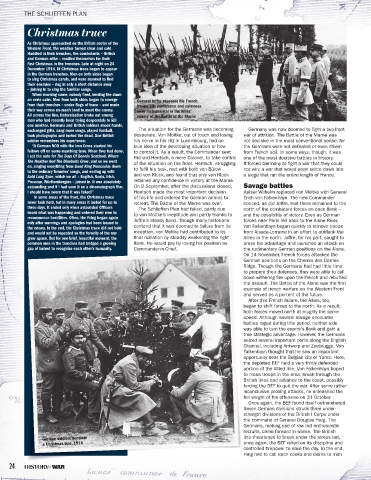
                     German soldiers decorate                                              line threatened to break under the stress but,
                     a Christmas tree, 1914                                                once again, the BEF relied on its discipline and
                                                                                           controlled fi repower to save the day. In the end,
                                                                                           Haig had to call upon cooks and clerks to man
         24   HISTORY  WAR
                       of


        HoW01.Germany strikes west.indd   24                                                                                 29/01/2014   18:17

