


Page 20 - History of War - Issue 01-14
P. 20
THE SCHLIEFFEN PLAN


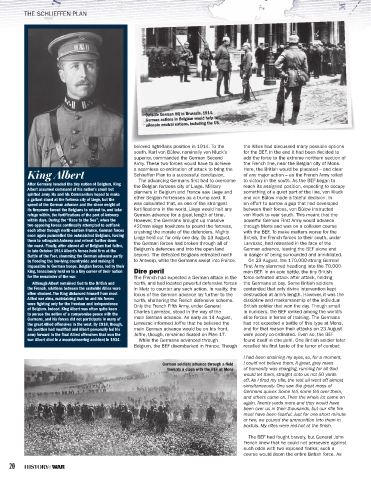
                                                         Outside German HQ in Brussels, 1914.
                                                         German actions in Belgium would help to
                                                         alienate neutral nations, including the US


                                                     beloved right-fl ank position in 1914. To the   the Allies had discussed many possible options
                                                     south, Karl von Bülow, nominally von Kluck’s   for the BEF, in the end it had been decided to
                                                     superior, commanded the German Second   add the force to the extreme northern section of
                                                     Army. These two forces would have to achieve   the French line, near the Belgian city of Mons.
               King Albert                           a seamless co-ordination of attack to bring the   Here, the British would be placated – and clear
                                                     Schlieffen Plan to a successful conclusion.
                                                                                           of any major action – as the French Army rolled
                                                      The advancing Germans fi rst had to overcome
               After Germany invaded the tiny nation of Belgium, King   the Belgian fortress city of Liege. Military   to victory in the south. As the BEF began to
                                                                                           reach its assigned position, expecting to occupy
               Albert assumed command of his nation’s small but   planners in Belgium and France saw Liege and   something of a quiet part of the line, von Kluck
               spirited army. He and his Commanders hoped to make
               a gallant stand at the fortress city of Liege, but the   other Belgian fortresses as a trump card. It   and von Bülow made a fateful decision. In
               speed of the German advance and the sheer weight of   was calculated that, as one of the strongest   an effort to narrow a gap that had developed
               its firepower forced the Belgians to retreat to, and take   fortifi cations in the world, Liege would halt any   between their forces, von Bülow instructed


               refuge within, the fortifications of the port of Antwerp   German advance for a great length of time.   von Kluck to veer south. This meant that the
               within days. During the “Race to the Sea”, when the   However, the Germans brought up massive   powerful German First Army would advance
               two opposing forces continually attempted to outflank   420mm siege howitzers to pound the fortress,   through Mons and was on a collision course

               each other through north-eastern France, German forces   crushing the morale of the defenders. Mighty   with the BEF. To make matters worse for the
               once again pummelled the outmatched Belgians, forcing   Liege held out for only one day. By 13 August,   British, the French forces to their south, under
               them to relinquish Antwerp and retreat further down   the German forces had broken through all of   Lanrezac, had retreated in the face of the
               the coast. Finally, after almost all of Belgium had fallen,
               in late October 1914 Albert’s forces held firm at the   Belgium’s defences and into the open land   German advance, leaving the BEF alone and

               Battle of the Yser, stemming the German advance partly   beyond. The defeated Belgians retreated north   in danger of being surrounded and annihilated.

               by flooding the low-lying countryside and making it   to Antwerp, while the Germans swept into France.  On 23 August, the 170,000-strong German
               impassible to German troops. Belgian forces, led by their                   First Army slammed headlong into the 70,000-
               King, tenaciously held on to a tiny corner of their nation   Dire peril     man BEF. In an epic battle, the tiny British
               for the remainder of the war.         The French had expected a German attack in the   force defeated attack after attack, holding
                 Although Albert remained tied to the British and   north, and had located powerful defensive forces   the Germans at bay. Some British soldiers
               the French, relations between the erstwhile Allies were   in Metz to counter any such action. In reality, the   contended that only divine intervention kept
               often strained. The King distanced himself from most   focus of the German advance lay further to the   destruction at arm’s length. However, it was the
               Allied war aims, maintaining that he and his forces   north, shattering the French defensive scheme.   discipline and marksmanship of the individual

               were fighting only for the freedom and independence   Only the French Fifth Army, under General   British soldier that won the day. Though small
               of Belgium. Indeed, King Albert was often quite keen
               to pursue the notion of a compromise peace with the   Charles Lanrezac, stood in the way of the   in numbers, the BEF ranked among the world’s
               Germans, and his forces did not participate in many of   main German advance. As early as 14 August,   elite forces in terms of training. The Germans
               the great Allied offensives in the west. By 1918, though,   Lanrezac informed Joffre that he believed the   had not expected a battle of this type at Mons,

               his position had modified and Albert personally led his   main German advance would be on his front.   and for that reason their attacks on 23 August

               army forward in the final Allied offensives that won the   Joffre, though, remained fi xated on Plan 17.  were poorly co-ordinated. Even so, the BEF
               war. Albert died in a mountaineering accident in 1934.  While the Germans advanced through   found itself in dire peril. One British soldier later
                                                     Belgium, the BEF disembarked in France. Though   recalled his fi rst taste of the terror of combat:

                                                                                           I had been straining my eyes, so, for a moment,

                                                               German soldiers advance through a field   I could not believe them. A great, grey mass
                                                                 towards a clash with the BEF at Mons  of humanity was charging, running for all God
                                                                                           would let them, straight onto us not 50 yards
                                                                                           off. As I fi red my rifl e, the rest all went off almost
                                                                                           simultaneously. One saw the great mass of
                                                                                           Germans quiver. Some fell, some fell over them,
                                                                                           and others came on. Then the whole lot came on
                                                                                           again. Twenty yards more and they would have
                                                                                           been over us in their thousands, but our rifl e fi re
                                                                                           must have been fearful. Just for one short minute
                                                                                           or two, we poured the ammunition into them in
                                                                                           boxfuls. My rifl es were red-hot at the fi nish.
                                                                                             The BEF had fought bravely, but General John
                                                                                           French knew that he could not persevere against
                                                                                           such odds with two exposed fl anks; such a
                                                                                           course would doom the entire British force. As
         20   HISTORY  WAR
                       of


        HoW01.Germany strikes west.indd   20                                                                                 29/01/2014   18:17

