


Page 185 - (DK Eyewitness) Travel Guide - The Netherlands
P. 185
NOR TH HOLLAND 183
Windmills
Since the 13th century, windmills have been an inseparable
part of the landscape of Holland. They have been used for a
variety of purposes, including milling corn, extracting oil and
sawing wood. One of their most important uses was to pump
away excess water from the polders (see pp168–9). Windmills
consist of a fixed tower and a cap which carries the sails. The
cap can be turned so that the sails face the wind. The sails can
be very dangerous when they are turning – hence the Dutch
saying, “Een klap van de molenwiek hebben” (“To be struck by a
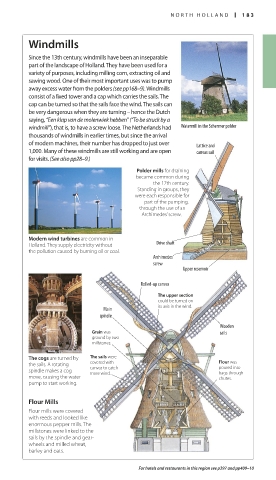
windmill”), that is, to have a screw loose. The Netherlands had Watermill in the Schermer polder
thousands of windmills in earlier times, but since the arrival
of modern machines, their number has dropped to just over Lattice and
1,000. Many of these windmills are still working and are open canvas sail
for visits. (See also pp28–9.)
Polder mills for draining
became common during
the 17th century.
Standing in groups, they
were each responsible for
part of the pumping,
through the use of an
Archimedes’ screw.
Modern wind turbines are common in
Holland. They supply electricity without Drive shaft
the pollution caused by burning oil or coal.
Archimedes’
screw
Upper reservoir
Rolled-up canvas
The upper section
could be turned on
its axis in the wind.
Main
spindle
Wooden
Grain was sails
ground by two
millstones.
The cogs are turned by The sails were
the sails. A rotating covered with Flour was
poured into
canvas to catch
spindle makes a cog more wind. bags through
move, causing the water chutes.
pump to start working.
Flour Mills
Flour mills were covered
with reeds and looked like
enormous pepper mills. The
millstones were linked to the
sails by the spindle and gear-
wheels and milled wheat,
barley and oats.
For hotels and restaurants in this region see p397 and pp409–10
182-183_EW_Netherlands.indd 183 16/01/17 12:04 pm

