


Page 268 - (DK Eyewitness) Travel Guide - The Netherlands
P. 268
266 NOR THERN AND EASTERN NE THERLANDS INTRODUCING THE NOR THERN AND EASTERN NE THERLANDS 267
Distinctive Landscapes
The northeast of the Netherlands has a number of
distinctive landscape types, such as the unique mud
flats, or Waddenzee, where the sand and clay is
exposed at low tide; the peat moors in southeast
Groningen; the enchanting heathland of Drenthe;
the endless polder landscape of Flevoland; the
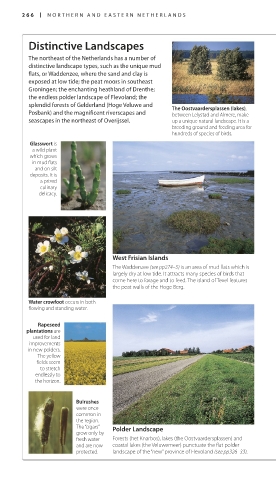
splendid forests of Gelderland (Hoge Veluwe and The Oostvaardersplassen (lakes),
Posbank) and the magnificent riverscapes and between Lelystad and Almere, make
seascapes in the northeast of Overijssel. up a unique natural landscape. It is a
breeding ground and feeding area for
hundreds of species of birds.
Glasswort is
a wild plant
which grows
in mud flats
and on silt
deposits. It is
a prized
culinary
delicacy.
West Frisian Islands
The Waddenzee (see pp274–5) is an area of mud flats which is
largely dry at low tide. It attracts many species of birds that
come here to forage and to feed. The island of Texel features
the peat walls of the Hoge Berg.
Water crowfoot occurs in both
flowing and standing water.
Rapeseed
plantations are
used for land
improvements
in new polders.
The yellow
fields seem
to stretch
endlessly to
the horizon.
Bulrushes
were once
common in
the region.
The “cigars” Polder Landscape
grow only by
fresh water Forests (het Knarbos), lakes (the Oostvaardersplassen) and
and are now coastal lakes (the Veluwemeer) punctuate the flat polder
protected. landscape of the “new” province of Flevoland (see pp326–33).
266-267_EW_Netherlands.indd 266 16/01/17 12:05 pm
Eyewitness Travel LAYERS PRINTED:
Feature template “UK” LAYER
(SourceReport v1.3)
Date 18th October 2012
Size 125mm x 217mm

