


Page 271 - (DK Eyewitness) Travel Guide - The Netherlands
P. 271
NOR THERN AND EASTERN NE THERLANDS 269
THE WEST FRISIAN
ISLANDS
Perhaps the least known part of the Netherlands despite
their natural beauty, the West Frisian Islands form a
barrier protecting the north of the country from the
turbulent waters of the North Sea. Comprising five
main islands and a few sandbanks, they are among
Europe’s last areas of wilderness.
The West Frisian Islands are the remaining still stand. Later, the islands prospered from
fragments of an ancient sandbank that links with the Dutch East India Company
once stretched from Cap Gris Nez in France and, in the 19th century, from whaling.
to Esbjerg in Denmark, a remnant of the Vlieland and Ameland are quieter islands,
last Ice Age. Since Roman times the sea has good for bird-watching. Schiermonnikoog
been eroding this sandbank, creating the is the most isolated, with rare plant life.
shallow Waddenzee behind and washing Nowadays the islands, reached by ferries
away much of the peat soil that lay beyond from the mainland, have much to offer
the dunes. The islands of Griend and the visitor in search of peace and quiet,
Rottumeroog were threatened to such with nature rambles over dunes and salt
an extent that they were abandoned. marsh, and seal- and bird-watching,
Rottumerplatt, too, is uninhabited. especially in summer. The islands’ quaint
Monks established the first settlements museums are strong on ecology and
as far back as the 8th century; islanders conser vation. The best way to get around
made a living from farming, fishing is by bicycle, and visitors will find a wide
and collecting shellfish. On Texel and range of hotels and guesthouses, excellent
Terschelling, the two largest islands, seafood restaurants, and some of the best
churches dating from the 15th century sunsets anywhere.
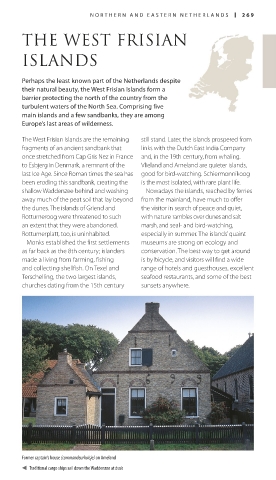
Former captain’s house (commandeurhuisje) on Ameland
Traditional cargo ships sail down the Waddenzee at dusk
268-269_EW_Netherlands.indd 269 14/03/2017 15:04

