


Page 272 - (DK Eyewitness) Travel Guide - The Netherlands
P. 272
270 NOR THERN AND EASTERN NE THERLANDS
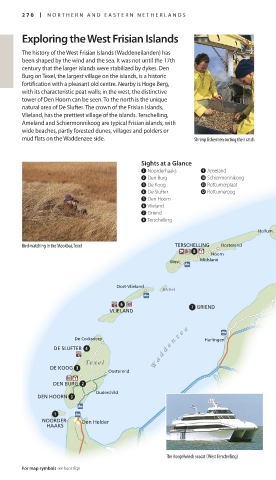
Exploring the West Frisian Islands
The history of the West Frisian Islands (Waddeneilanden) has
been shaped by the wind and the sea. It was not until the 17th
century that the larger islands were stabilized by dykes. Den
Burg on Texel, the largest village on the islands, is a historic
fortification with a pleasant old centre. Nearby is Hoge Berg,
with its characteristic peat walls; in the west, the distinctive
tower of Den Hoorn can be seen. To the north is the unique
natural area of De Slufter. The crown of the Frisian Islands,
Vlieland, has the prettiest village of the islands. Terschelling,
Ameland and Schiermonnikoog are typical Frisian islands, with
wide beaches, partly forested dunes, villages and polders or
mud flats on the Waddenzee side. Shrimp fishermen sorting their catch
Sights at a Glance
1 Noorderhaaks 9 Ameland
2 Den Burg 0 Schiermonnikoog
3 De Koog q Rottumerplaat
4 De Slufter w Rottumeroog ROTTUMERPLAAT
5 Den Hoorn ROTTUMEROOG
6 Vlieland SCHIERMONNIKOOG
7 Griend
8 Terschelling AMELAND Schiermonnikoog
Hollum Nes Buren
Bird-watching in the Mookbai, Texel TERSCHELLING Oosterend W a d d e n z e e Lauwersoog
Hoorn Holwerd
West Midsland
Oost-Vlieland
Richel
GRIEND
VLIELAND
n z e e
De Cocksdorp Harlingen
e
DE SLUFTER d
d
Te x e l W a
DE KOOG
Oosterend
DEN BURG
Oudeschild
DEN HOORN
NOORDER- Den Helder
HAAKS
The Koegelwieck seacat (West Terschelling)
For map symbols see back flap
270-271_EW_Netherlands.indd 270 16/01/17 12:05 pm
Eyewitness Travel LAYERS PRINTED:
Explorer template “UK” LAYER
(Source v1.4)
Date 5th December 2012
Size 125mm x 217mm

