


Page 269 - (DK Eyewitness) Travel Guide - The Netherlands
P. 269
INTRODUCING THE NOR THERN AND EASTERN NE THERLANDS 267
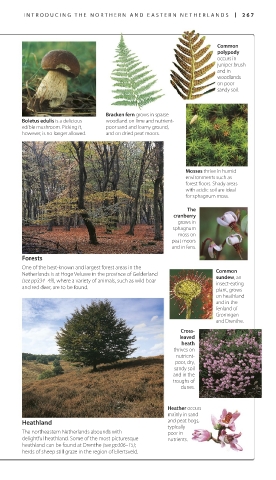
Common
polypody
occurs in
juniper brush
and in
woodlands
on poor
sandy soil.
Bracken fern grows in sparse
Boletus edulis is a delicious woodland on lime and nutrient-
edible mushroom. Picking it, poor sand and loamy ground,
however, is no longer allowed. and on dried peat moors.
Mosses thrive in humid
environments such as
forest floors. Shady areas
with acidic soil are ideal
for sphagnum moss.
The
cranberry
grows in
sphagnum
moss on
peat moors
and in fens.
Forests
One of the best-known and largest forest areas in the
Netherlands is at Hoge Veluwe in the province of Gelderland Common
(see pp334–49), where a variety of animals, such as wild boar sundew, an
insect-eating
and red deer, are to be found.
plant, grows
on heathland
and in the
fenland of
Groningen
and Drenthe.
Cross-
leaved
heath
thrives on
nutrient-
poor, dry,
sandy soil
and in the
troughs of
dunes.
Heather occurs
mainly in sand
Heathland and peat bogs,
typically
The northeastern Netherlands abounds with poor in
delightful heathland. Some of the most picturesque nutrients.
heathland can be found at Drenthe (see pp306–15);
herds of sheep still graze in the region of Ellertsveld.
266-267_EW_Netherlands.indd 267 16/01/17 12:05 pm

