


Page 286 - (DK Eyewitness) Travel Guide - The Netherlands
P. 286
284 NOR THERN AND EASTERN NE THERLANDS
1 Street-by-Street: Groningen
The town of Groningen has for centuries been the cultural
and historical capital of the province. Its glory was at its
height in the 15th century, when the town was freed from
the jurisdiction of the Bishop of Utrecht and was able to
extend its influence into the present-day province of T U R F S I N G E L
Friesland. In 1614, the Groninger Academie was founded,
which was the precursor of the Rijksuniversiteit. Thus, in
addition to being a centre of trade and government, the
town also became an academic centre. TURFSTR AAT
S
I N
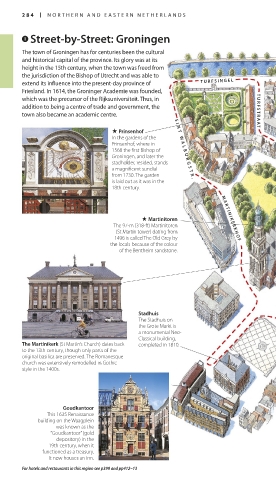
. Prinsenhof
In the gardens of the T W A
Prinsenhof, where in L
1568 the first Bishop of B
Groningen, and later the U R
stadholder, resided, stands G
a magnificent sundial S
T
from 1730. The garden R .
is laid out as it was in the
18th century.
. Martinitoren M A R T I N I K E R K H O F
The 97-m (318-ft) Martinitoren
(St Martin tower) dating from
1496 is called The Old Grey by
the locals because of the colour
of the Bentheim sandstone.
Stadhuis G R O T E M A R K T
The Stadhuis on
the Grote Markt is
a monumental Neo-
Classical building,
The Martinikerk (St Martin’s Church) dates back completed in 1810.
to the 13th century, though only parts of the
original basilica are preserved. The Romanesque
church was extensively remodelled in Gothic
style in the 1400s.
Goudkantoor
This 1635 Renaissance
building on the Waagplein
was known as the
“Goudkantoor” (gold
depository) in the
19th century, when it
functioned as a treasury.
It now houses an inn.
For hotels and restaurants in this region see p399 and pp412–13
284-285_EW_Netherlands.indd 284 16/01/17 12:06 pm
Eyewitness Travel LAYERS PRINTED:
Starsight template “UK” LAYER
(Source v2.7)
Date 24th April 2013
Size 125mm x 217mm

