


Page 329 - (DK Eyewitness) Travel Guide - The Netherlands
P. 329
FLE VOLAND 327
FLEVOLAND
Flevoland is Holland’s youngest province, constructed
by the Dutch entirely out of water, sandbanks and mud
flats, thanks to massive reclamation schemes which
created dykes and polders (reclaimed land, sometimes
below sea level) from the turbulent Zuiderzee
following an Act of Parliament in 1918.
This act provided funds for damming occasional village here and there.
the northeastern part of the Zuiderzee However, as the built-up areas around
and reclaiming the land behind the Amsterdam and Utrecht became
dykes. When the Afsluitdijk was completed increasingly congested, new towns
in 1932, drainage works on the have grown up. The conurbation around
Noordostpolder began and, with the Almere, with its highly impressive
seawater pumped out, the islands of modern architecture, is among these.
Urk and Schokland and the town of Other towns include Lelystad, with its
Emmeloord became by 1942 a part of several modern museums, and Dronten,
the mainland. Further schemes to the where the Walibi World amusement
south and southwest were completed park proves an irresistible magnet for
in 1957 and 1968 respectively, and since younger visitors. Lelystad, whose name
1986 these three new polders have honours Cornelius Lely, the genius
offi cially constituted the Netherlands’ behind the massive land creation project
newest province, named Flevoland after (see p330), is the provincial capital. There
“Flevo Lacus”, the original name given to are many other attractions for visitors
the Zuiderzee by the Roman historian to this compact and attractive region,
Pliny nearly 2,000 years ago. including a number of fascinating
Initially, the idea had been to use museums featuring subjects as varied
the polders as farmland only, with the as archaeology and World War II.
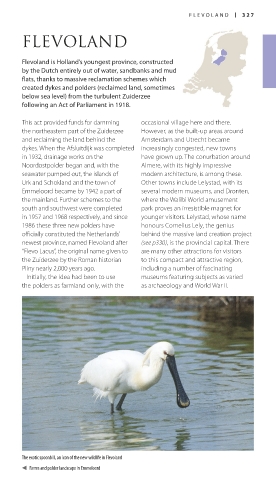
The exotic spoonbill, an icon of the new wildlife in Flevoland
Farms and polder landscape in Emmeloord
326-327_EW_Netherlands.indd 327 14/03/2017 15:04

