


Page 334 - (DK Eyewitness) Travel Guide - The Netherlands
P. 334
332 NOR THERN AND EASTERN NE THERLANDS
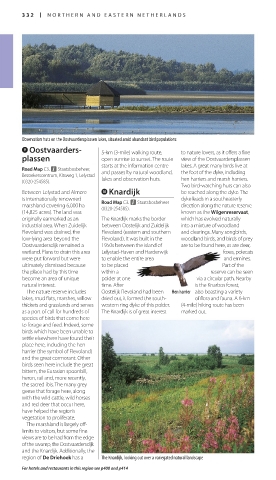
Observation huts on the Oostvaardersplassen lakes, situated amid abundant bird populations
9 Oostvaarders 5-km (3-mile) walking route, to nature lovers, as it offers a fine
plassen open sunrise to sunset. The route view of the Oostvaardersplassen
starts at the information centre lakes. A great many birds live at
Road Map C3. n Staatsbosbeheer, and passes by natural woodland, the foot of the dyke, including
Bezoekerscentrum, Kitsweg 1, Lelystad
(0320-254585). lakes and observation huts. hen harriers and marsh harriers.
Two bird-watching huts can also
Between Lelystad and Almere 0 Knardijk be reached along the dyke. The
is internationally renowned Road Map C3. n Staatsbosbeheer dyke leads in a southeasterly
marshland covering 6,000 ha (0320-254585). direction along the nature reserve
(14,825 acres). The land was known as the Wilgenreservaat,
originally earmarked as an The Knardijk marks the border which has evolved naturally
industrial area. When Zuidelijk between Oostelijk and Zuidelijk into a mixture of woodland
Flevoland was drained, the Flevoland (eastern and southern and clearings. Many songbirds,
low-lying area beyond the Flevoland). It was built in the woodland birds, and birds of prey
Oostvaardersdijk remained a 1950s between the island of are to be found here, as are deer,
wetland. Plans to drain this area Lelystad-Haven and Harderwijk foxes, polecats
were put forward but were to enable the entire area and ermines.
ultimately dismissed because to be placed Part of the
the place had by this time within a reserve can be seen
become an area of unique polder at one via a circular path. Nearby
natural interest. time. After is the Knarbos forest,
The nature reserve includes Oost elijk Flevoland had been Hen harrier also boasting a variety
lakes, mud flats, marshes, willow dried out, it formed the south- of flora and fauna. A 6-km
thickets and grasslands and serves western ring dyke of this polder. (4-mile) hiking route has been
as a port of call for hundreds of The Knardijk is of great interest marked out.
species of birds that come here
to forage and feed. Indeed, some
birds which have been unable to
settle elsewhere have found their
place here, including the hen
harrier (the symbol of Flevoland)
and the great cormorant. Other
birds seen here include the great
bittern, the Eurasian spoonbill,
heron, rail and, more recently,
the sacred ibis. The many grey
geese that forage here, along
with the wild cattle, wild horses
and red deer that occur here,
have helped the region’s
vegetation to proliferate.
The marshland is largely off-
limits to visitors, but some fine
views are to be had from the edge
of the swamp, the Oostvaardersdijk
and the Knardijk. Additionally, the
region of De Driehoek has a The Knardijk, looking out over a variegated natural landscape
For hotels and restaurants in this region see p400 and p414
332-333_EW_Netherlands.indd 332 16/01/17 12:07 pm
Eyewitness Travel LAYERS PRINTED:
Catalogue template “UK” LAYER
(Source v2.4)
Date 25th April 2013
Size 125mm x 217mm

