


Page 53 - (DK Eyewitness) Travel Guide - The Netherlands
P. 53
THE HIST OR Y OF THE NE THERLANDS 51
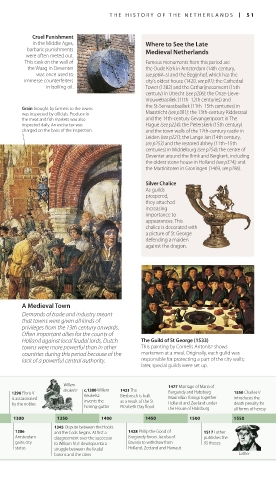
Cruel Punishment
In the Middle Ages, Where to See the Late
barbaric punishments Medieval Netherlands
were often meted out.
This cask on the wall of Famous monuments from this period are
the Waag in Deventer the Oude Kerk in Amsterdam (14th century,
was once used to see pp84–5) and the Begijnhof, which has the
immerse counterfeiters city’s oldest house (1420, see p91); the Cathedral
in boiling oil. Tower (1382) and the Catharijneconvent (15th
century) in Utrecht (see p206); the Onze-Lieve-
Vrouwebasiliek (11th–12th centuries) and
the St-Servaasbasiliek (11th–15th centuries) in
Grain brought by farmers to the towns
was inspected by officials. Produce in Maastricht (see p381); the 13th-century Ridderzaal
the meat and fish markets was also and the 14th-century Gevangenpoort in The
inspected daily. An excise tax was Hague (see p224); the Pieterskerk (15th century)
charged on the basis of the inspection. and the town walls of the 12th-century castle in
Leiden (see p221); the Lange Jan (14th century,
see p253) and the restored abbey (11th–15th
centuries) in Middelburg (see p254); the centre of
Deventer around the Brink and Bergkerk, including
the oldest stone house in Holland (see p324); and
the Martinitoren in Groningen (1469, see p286).
Silver Chalice
As guilds
prospered,
they attached
increasing
importance to
appearances. This
chalice is decorated with
a picture of St George
defending a maiden
against the dragon.
A Medieval Town
The sheriff, with his Demands of trade and industry meant
distinctive chain of bells, that towns were given all kinds of
was the representative of the privileges from the 13th century onwards.
sovereign. Here he is on the
way to pronounce a death Often important allies for the counts of
sentence, which is shown by Holland against local feudal lords, Dutch The Guild of St George (1533)
the red pole, the “rod of justice”, towns were more powerful than in other This painting by Cornelis Antonisz shows
carried by an executioner. countries during this period because of the marksmen at a meal. Originally, each guild was
lack of a powerful central authority. responsible for protecting a part of the city walls;
later, special guilds were set up.
Willem 1477 Marriage of Maria of
Beukelsz c.1380 Willem 1421 The
1296 Floris V Beukelsz. Biesbosch is built Burgundy and Habsburg 1550 Charles V
is assassinated invents the as a result of the St Maximilian I brings together introduces the
by the nobles Holland and Zeeland under death penalty for
herring-gutter Elizabeth Day flood the House of Habsburg all forms of heresy
1250 1300 1350 1400 1450 1500 1550
1345 Dispute between the Hooks
1306 and the Cods begins. At first a 1428 Philip the Good of 1517 Luther
Amsterdam disagreement over the successor Burgundy forces Jacoba of publishes the
gains city to William IV, it develops into a Bavaria to withdraw from 95 theses
status struggle between the feudal Holland, Zeeland and Hainaut
barons and the cities Luther
050-051_EW_Netherlands.indd 51 16/01/17 12:02 pm

