


Page 58 - (DK Eyewitness) Travel Guide - The Netherlands
P. 58
56 INTRODUCING THE NE THERLANDS
Calvinism
From the end of the 1500s, Calvinism took hold in
the Netherlands as Protestant opposition to Spanish
Catholic rule. Amsterdam, which had sided with Spain,
switched loyalties in 1578 to become the fiercely
Protestant capital of an infant Dutch Republic. Reformed
Church doctrine was to have a profound influence on
Dutch history. Strict living and industriousness became
ingrained in the character of Calvinists as well as of
Catholics and agnostics and was instrumental in the
country’s prosperity during the Golden Age.
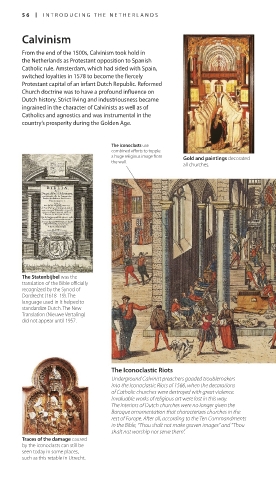
The iconoclasts use
combined efforts to topple
a huge religious image from Gold and paintings decorated
the wall.
all churches.
The Statenbijbel was the
translation of the Bible officially
recognized by the Synod of
Dordrecht (1618–19). The
language used in it helped to
standardize Dutch. The New
Translation (Nieuwe Vertaling)
did not appear until 1957.
The Iconoclastic Riots
Underground Calvinist preachers goaded troublemakers
into the Iconoclastic Riots of 1566, when the decorations
of Catholic churches were destroyed with great violence.
Invaluable works of religious art were lost in this way.
The interiors of Dutch churches were no longer given the
Baroque ornamentation that characterizes churches in the
rest of Europe. After all, according to the Ten Commandments
in the Bible, “Thou shalt not make graven images” and “Thou
shalt not worship nor serve them”.
Traces of the damage caused
by the iconoclasts can still be
seen today in some places,
such as this retable in Utrecht.
056-057_EW_Netherlands.indd 56 16/01/17 12:03 pm
Eyewitness Travel LAYERS PRINTED:
Feature template “UK” LAYER
(SourceReport v1.3)
Date 18th October 2012
Size 125mm x 217mm

