


Page 62 - (DK Eyewitness) Travel Guide - The Netherlands
P. 62
60 INTRODUCING THE NE THERLANDS
Colonialism
Dutch colonial history started in the 17th century when trading
settlements were established in Asia, Africa and America. Many
colonies were lost during the course of time, but the Dutch Indies
(Indonesia), Suriname and the Dutch Antilles remained under Dutch
rule until far into the 20th century. In the Indonesian archipelago,
Dutch power was for a long time limited to Java and the Moluccas.
It was only in 1870 that a start was made on subjugating the
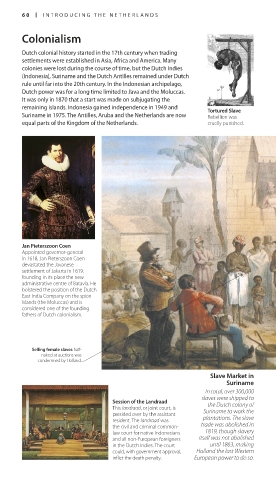
remaining islands. Indonesia gained independence in 1949 and Tortured Slave
Suriname in 1975. The Antilles, Aruba and the Netherlands are now Rebellion was
equal parts of the Kingdom of the Netherlands. cruelly punished.
Jan Pieterszoon Coen
Appointed governor-general
in 1618, Jan Pieterszoon Coen
devastated the Javanese
settlement of Jakarta in 1619,
founding in its place the new
administrative centre of Batavia. He
bolstered the position of the Dutch
East India Company on the spice
islands (the Moluccas) and is
considered one of the founding
fathers of Dutch colonialism.
Selling female slaves half-
naked at auctions was
condemned by Holland.
Slave Market in
Suriname
In total, over 300,000
slaves were shipped to
Session of the Landraad the Dutch colony of
This landraad, or joint court, is
presided over by the assistant Suriname to work the
resident. The landraad was plantations. The slave
the civil and criminal common- trade was abolished in
law court for native Indonesians 1819, though slavery
and all non-European foreigners itself was not abolished
in the Dutch Indies. The court until 1863, making
could, with government approval, Holland the last Western
inflict the death penalty. European power to do so.
060-061_EW_Netherlands.indd 60 16/01/17 12:03 pm

