


Page 63 - (DK Eyewitness) Travel Guide - The Netherlands
P. 63
THE HIST OR Y OF THE NE THERLANDS 61
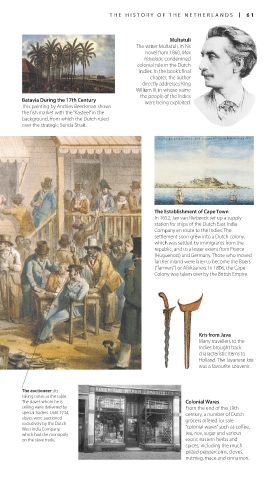
Multatuli
The writer Multatuli, in his
novel from 1860, Max
Havelaar, condemned
colonial rule in the Dutch
Indies. In the book’s final
chapter, the author
directly addresses King
William III, in whose name
the people of the Indies
Batavia During the 17th Century were being exploited.
This painting by Andries Beeckman shows
the fish market with the “Kasteel” in the
background, from which the Dutch ruled
over the strategic Sunda Strait.
The Establishment of Cape Town
In 1652, Jan van Riebeeck set up a supply
station for ships of the Dutch East India
Company en route to the Indies. The
settlement soon grew into a Dutch colony,
which was settled by immigrants from the
republic, and to a lesser extent from France
(Huguenots) and Germany. Those who moved
farther inland were later to become the Boers
(“farmers”) or Afrikaaners. In 1806, the Cape
Colony was taken over by the British Empire.
Kris from Java
Many travellers to the
Indies brought back
characteristic items to
Holland. The Javanese kris
was a favourite souvenir.
The auctioneer sits
taking notes at the table.
The slaves whom he is Colonial Wares
selling were delivered by From the end of the 19th
special traders. Until 1734, century, a number of Dutch
slaves were auctioned grocers offered for sale
exclusively by the Dutch
West India Company, “colonial wares” such as coffee,
which had the monopoly tea, rice, sugar and various
on the slave trade. exotic eastern herbs and
spices, including the much-
prized peppercorns, cloves,
nutmeg, mace and cinnamon.
060-061_EW_Netherlands.indd 61 16/01/17 12:03 pm

