


Page 21 - (DK Eyewitness) Travel Guide - Milan & The Lakes
P. 21
INTRODUCING MILAN 19
THE HISTORY OF MILAN
According to the words of a 17th-century ambassador, “Milan never fails to be
a great city, and when it declines it soon becomes great again”. The sentiments
encapsulate one of the characteristics of the city – its ability to rise from the ruins
of wars, epidemics, sieges and bombings suffered over the centuries, and to regain
dynamism and prosperity once more.
The Prehistoric and Roman City Western Roman Empire (until 402)
In the 3rd–2nd millen nium BC, the and was the residence of Emperor
area covered by Milan today was Maximian. By the late Imperial era
inhabited by the Ligurians. It was later Milan was the most important city
settled by Indo‑European populations in the West after Rome and it became
and then, in the 5th century BC, by a leading religious centre after
the Etruscans. Around the lakes, Constantine’s Edict of Milan in 313,
archaeologists have unearthed which officially recognized Christianity
fascinating pre‑Roman objects that as a religion. Sant’Ambrogio (Ambrose)
reveal the presence of a Celtic civiliza ‑ exerted great influence at this time.
tion in the 9th–6th centuries BC. He was the first great figure in Milan’s
Milan itself was founded in the early history: a Doctor of the Church, he
4th century BC when the Gallic Insubre built four basilicas (San Simpliciano,
tribes settled there. Sant’Ambrogio, San Lorenzo, San Nazaro)
The origins of the city are somewhat and was a leading opponent of the Arian
obscure, as is its name, which most heresy (which denied the divinity of
scholars say derives from Midland (or Christ). Sant’Ambrogio was the first in
“middle of the plain”), while others a long series of bishops who ran the
say it derives from scrofa semilanuta city’s affairs in the early Middle Ages.
(half‑woolly boar), the city emblem in Roman Milan was a substantial size:
ancient times. In 222 BC the Romans, the Republican walls, enlarged to the
led by the consuls Gnaeus Cornelius northeast during the Imperial Age,
Scipio Calvus and Claudius Marcellus, defined an area that was roughly the
defeated the Celts and conquered same size as the present‑day city centre.
the Po river valley and its cities. Milan The few traces of public buildings that
soon became a flourishing com mercial remain, such as the Colonne di San
centre and in the Imperial era attained Lorenzo and the remains in Via Circo,
political and administrative independence. attest to the importance of Milan’s role
In AD 286 it became the capital of the at the time.
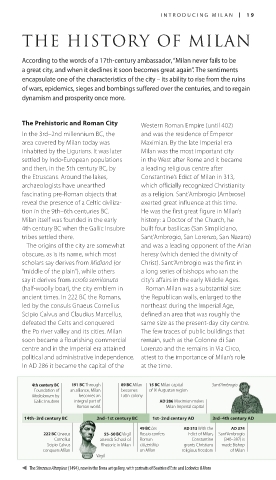
4th century BC 191 BC Through 89 BC Milan 15 BC Milan capital Sant’Ambrogio
Foundation of an alliance, Milan becomes of IX Augustan region
Mediolanum by becomes an Latin colony
Gallic Insubres integral part of AD 286 Maximian makes
Roman world Milan Imperial capital
14th–3rd century BC 2nd–1st century BC 1st–2nd century AD 3rd–4th century AD
49 BC Lex AD 313 With the AD 374
222 BC Gnaeus 55–50 BC Virgil Roscia confers Edict of Milan, Sant’Ambrogio
Cornelius attends School of Roman Constantine (340–397) is
Scipio Calvus Rhetoric in Milan citizenship grants Christians made Bishop
conquers Milan on Milan religious freedom of Milan
Virgil
The Sforzesca Altarpiece (1494), now in the Brera art gallery, with portraits of Beatrice d’Este and Lodovico il Moro
018-019_EW_Milan.indd 19 20/10/16 3:19 pm

