


Page 26 - (DK Eyewitness) Travel Guide - Milan & The Lakes
P. 26
24 INTRODUCING MILAN
France and Spain expanded and from 1548
The Renaissance petered out to 1560 new city walls were
in the 16th century and was built (called the Spanish walls)
followed by a long period of corres ponding to today’s inner
decline. Milan was greatly ring road. The walls were the
affected by the loss of political most important public works
and military importance on the undertaken during Spanish
part of the Italian states, now rule. All that is left now is Porta
battlefields for other European Romana arch, though not in its
powers, and because of its wealth original position. Many Baroque
and strategic position the city buildings, such as Palazzo Durini
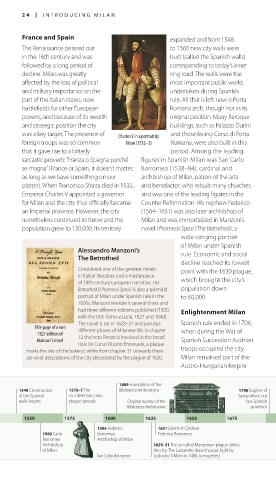
was a key target. The presence of Charles V in a portrait by and those facing Corso di Porta
foreign troops was so common Titian (1532–3) Romana, were also built in this
that it gave rise to a bitterly period. Among the leading
sarcastic proverb: “Franza o Spagna purché figures in Spanish Milan was San Carlo
se magna” (France or Spain, it doesn’t matter, Borromeo (1538–84), cardinal and
as long as we have something on our archbishop of Milan, patron of the arts
platter). When Francesco Sforza died in 1535, and benefactor, who rebuilt many churches
Emperor Charles V appointed a governor and was one of the leading figures in the
for Milan and the city thus officially became Counter Reformation. His nephew Federico
an Imperial province. However, the city (1564–1631) was also later archbishop of
nonetheless con tinued to thrive and the Milan and was immortalized in Manzoni’s
population grew to 130,000. Its territory novel I Promessi Sposi (The Betrothed), a
wide-ranging portrait
of Milan under Spanish
Alessandro Manzoni’s rule. Economic and social
The Betrothed
decline reached its lowest
Considered one of the greatest novels point with the 1630 plague,
in Italian literature and a masterpiece
of 19th-century European narrative, The which brought the city’s
Betrothed (I Promessi Sposi) is also a splendid population down
portrait of Milan under Spanish rule in the to 60,000.
1600s. Manzoni rewrote it several times and
had three different editions published (1820, Enlightenment Milan
with the title Fermo e Lucia, 1827 and 1840).
The novel is set in 1628–31 and portrays Spanish rule ended in 1706,
Title page of a rare
1827 edition of different phases of Milanese life. In chapter when during the War of
Manzoni’s novel 12 the hero Renzo is involved in the bread Spanish Succession Austrian
riots (in Corso Vittorio Emanuele, a plaque
marks the site of the bakery), while from chapter 31 onwards there troops occupied the city.
are vivid descriptions of the city devastated by the plague of 1630. Milan remained part of the
Austro-Hungarian Empire
1609 Foundation of the
1548 Construction 1576–7 The Biblioteca Ambrosiana 1706 Eugene of
of the Spanish so-called San Carlo Savoy drives out
walls begins plague spreads Original nucleus of the last Spanish
Biblioteca Ambrosiana governor
1550 1575 1600 1625 1650 1675 1700
1595 Federico 1631 Death of Cardinal
1560 Carlo Borromeo Federico Borromeo
Borromeo Archbishop of Milan
Archbishop 1629–31 The so-called Manzonian plague strikes
of Milan the city. The Lazzaretto (leper-house), built by
San Carlo Borromeo Lodovico il Moro in 1480, is reopened
024-025_EW_Milan.indd 24 20/10/16 3:19 pm
Eyewitness Travel LAYERS PRINTED:
History Portrait template “UK” LAYER
(Source v1.2)
Date 20th August 2012
Size 125mm x 217mm

