


Page 25 - (DK Eyewitness) Travel Guide - Milan & The Lakes
P. 25
THE HIST OR Y OF MILAN 23
Sforza
After the three-year Ambrosian
Republic, the city had a new duke
in 1450, Francesco Sforza, the
condottiere son of Muzio
Attendolo, known as “Sforza”. The
50 years of Sforza family rule were
the most prosperous and splendid
Milan had ever enjoyed. Art and
Francesco I commerce flourished, particularly
This great warrior had fought for Muzio Attendolo under Lodovico il Moro. However,
Filippo Maria Visconti, and married Count of Cotignola his unscrupulous foreign policy led
his daughter Bianca Maria. In 1454 † 1424 to the fall of the dukedom and the
he began expanding the duchy end of freedom in Milan.
through peaceful means until it
included Genoa and Corsica.
FRANCESCO I
Andreotto Natural son of Lucia Terzani,
married Bianca Maria Visconti
Duke of Milan from 1450
† 1466
LODOVICO called IL MORO
GALEAZZO MARIA Duke of Milan from 1494 Ascanio
Duke of Milan from 1466 † 1508 Became cardinal in 1484
† 1476 † 1505
Lodovico Il Moro
Born in 1452, he
usurped power from
GIAN GALEAZZO MARIA
Duke of Milan from 1476 his nephew Gian
† 1494 Galeazzo Maria in
1480. After being
defeated at Novara
Bianca Maria (1500) he was exiled
wife of Emperor Maximilian to France and died
of Habsburg
† 1510 there in 1508.
Bona
wife of Sigismund I
King of Poland
† 1558
ERCOLE MASSIMILIANO FRANCESCO II
Duke of Milan (1512–15) Duke of Milan
† 1530 (1521–24; 1525; 1529–35) † 1535
Where to See Visconti and Sforza Milan
The Milan of the Visconti family is basically Gothic. The
main monuments either started or completed under
Visconti rule are the Duomo (see pp48–51), San Gottardo
(see p56) and San Marco (though it has been radically
altered: see p114). Under the Sforza family there was a
transition from Gothic to Renaissance architecture, as can
be seen in San Pietro in Gessate (see p101) and especially in
Santa Maria delle Grazie, where Leonardo painted The Last
Supper (see pp73–5). The Ospedale Maggiore, or Ca’ Granda
(see p99), was designed by Filarete for Francesco Sforza,
and the Castello Sforzesco (see pp66–9) was built by the
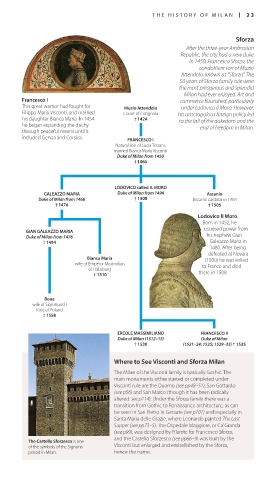
The Castello Sforzesco is one
of the symbols of the Signoria Visconti but enlarged and embellished by the Sforza,
period in Milan. hence the name.
022-023_EW_Milan.indd 23 20/10/16 3:19 pm

