


Page 23 - (DK Eyewitness) Travel Guide - Milan & The Lakes
P. 23
THE HIST OR Y OF MILAN 21
In the 13th century, Milan created a under his lead came to an end with his
formidable canal network, the Navigli, death in 1402. The Visconti dynasty died
which linked the city to Ticino in out in 1447 and for three years the city
Switzerland. However, power struggles enjoyed self-government under the
among the leading families sapped Ambrosian Republic. In 1450 the
the strength of the entire city and condottiere Francesco Sforza
foreshadowed its decline. initiated what was perhaps the
most felicitous period in the
The Great Dynasties history of Milan: he abandoned
In 1277 at Desio, the Visconti, the Visconti expansionist policy
under Archbishop Ottone, and secured lasting peace
overthrew the Torriani family. for the city, which flourished
The Visconti then summoned and grew to a population of
the leading artists of the time, Coat of arms of the 100,000. The Visconti castle was
including Giotto, to Milan to Visconti family rebuilt and became the Castello
embellish the city and its palazzi, Sforzesco (see pp66–9), while
and they com missioned new buildings architects such as Guiniforte Solari and
such as the Castello and the Duomo Filarete began work on the Ospedale
(see pp48–51). The height of Visconti Maggiore, better known as Ca’ Granda
power was achieved under Gian Galeazzo, (see p99). However, Milan’s cultural golden
who became duke in 1395 and undertook age came with Lodovico Sforza, known
an ambitious policy of expansion. Milan as “il Moro” (1479–1508). He was an
soon ruled most of Northern Italy and undisciplined politician but a great patron
even controlled some cities in Tuscany, of the arts. His policy of alliances and
but the duke’s dream of a united Italy strategic decisions marked the end of
freedom for Milan, which in 1499 fell
under French dominion, yet during his
rule Milanese arts and culture were
second only to Medici Florence. From
1480 on, great men such as Bramante
and Leonardo da Vinci were active in
Milan. The former restored numerous
churches and designed Santa Maria
delle Grazie (see p73), in whose
refectory Leonardo painted The Last
Supper (see pp74–5), one of his many
masterpieces. Leonardo also worked
on major city projects such as the
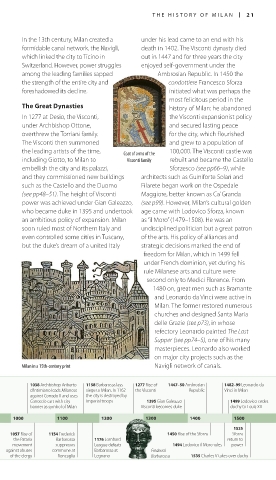
Milan in a 15th-century print Navigli network of canals.
1038 Archbishop Ariberto 1158 Barbarossa lays 1277 Rise of 1447–50 Ambrosian 1482–99 Leonardo da
d’Intimiano leads Milanese siege to Milan. In 1162 the Visconti Republic Vinci in Milan
against Corrado II and uses the city is destroyed by
Carroccio cart with city Imperial troops 1395 Gian Galeazzo 1499 Lodovico cedes
banner as symbol of Milan Visconti becomes duke duchy to Louis XII
900 1000 1100 1200 1300 1400 1500
1525
1057 Rise of 1154 Frederick 1450 Rise of the Sforza Sforza
the Pataria Barbarossa 1176 Lombard return to
movement suppresses League defeats 1494 Lodovico il Moro rules power
against abuses commune at Barbarossa at Frederick
of the clergy Roncaglia Legnano Barbarossa 1535 Charles V takes over duchy
020-021_EW_Milan.indd 21 16/10/14 1:48 PM

