


Page 14 - The Complete Cat Breed Book (DK)
P. 14
12      INTR ODUC TION T O C A T S


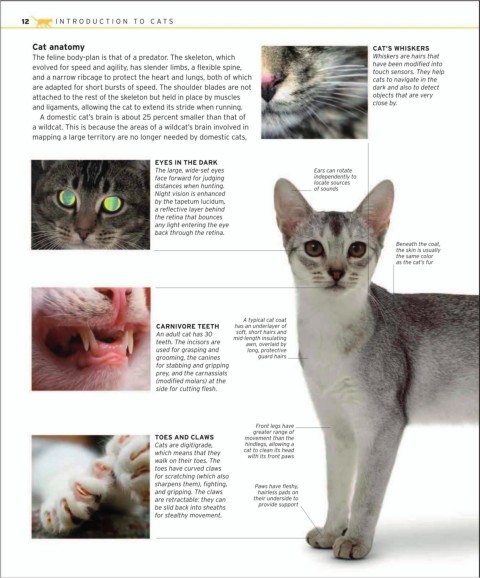
        Cat anatomy                                                                    CAT’S WHISKERS
        The feline body-plan is that of a predator. The skeleton, which                Whiskers are hairs that
                                                                                       have been modified into
        evolved for speed and agility, has slender limbs, a flexible spine,
                                                                                       touch sensors. They help
        and a narrow ribcage to protect the heart and lungs, both of which             cats to navigate in the
        are adapted for short bursts of speed. The shoulder blades are not             dark and also to detect
        attached to the rest of the skeleton but held in place by muscles              objects that are very
                                                                                       close by.
        and ligaments, allowing the cat to extend its stride when running.
          A domestic cat’s brain is about 25 percent smaller than that of
        a wildcat. This is because the areas of a wildcat’s brain involved in
        mapping a large territory are no longer needed by domestic cats,


                                     EYES IN THE DARK
                                     The large, wide-set eyes            Ears can rotate
                                     face forward for judging            independently to
                                                                         locate sources
                                     distances when hunting.
                                                                         of sounds
                                     Night vision is enhanced
                                     by the tapetum lucidum,
                                     a reflective layer behind
                                     the retina that bounces
                                     any light entering the eye
                                     back through the retina.
                                                                                            Beneath the coat,
                                                                                            the skin is usually
                                                                                            the same color
                                                                                            as the cat’s fur


                                                         A typical cat coat
                                     CARNIVORE TEETH   has an underlayer of
                                                       soft, short hairs and
                                     An adult cat has 30   mid-length insulating
                                     teeth. The incisors are   awn, overlaid by
                                     used for grasping and   long, protective
                                     grooming, the canines   guard hairs
                                     for stabbing and gripping
                                     prey, and the carnassials
                                     (modified molars) at the
                                     side for cutting flesh.


                                                            Front legs have
                                                           greater range of
                                     TOES AND CLAWS      movement than the
                                     Cats are digitigrade,   hindlegs, allowing a
                                     which means that they   cat to clean its head
                                                          with its front paws
                                     walk on their toes. The
                                     toes have curved claws
                                     for scratching (which also
                                     sharpens them), fighting,   Paws have fleshy,
                                     and gripping. The claws   hairless pads on
                                     are retractable: they can   their underside to
                                     be slid back into sheaths   provide support
                                     for stealthy movement.

