


Page 214 - The Complete Cat Breed Book (DK)
P. 214
212      C ARE AND BEHA VIOR


        FOOD AND FEEDING


        A well-fed and well-nourished cat is a happy cat. Although the
        occasional mouse caught outside may supplement your cat’s diet,
        he will rely on you almost exclusively for his food. And that reliance
        places great responsibility on you. Providing your cat with a healthy,
        balanced diet will help him to grow and develop as he should, and
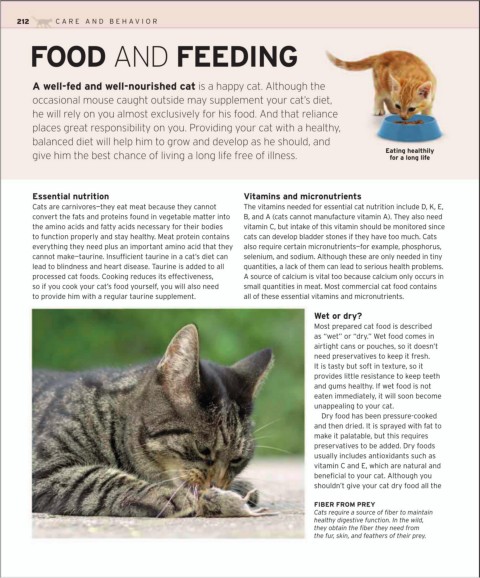
                                                                                          Eating healthily
        give him the best chance of living a long life free of illness.                    for a long life


        Essential nutrition                              Vitamins and micronutrients
        Cats are carnivores—they eat meat because they cannot   The vitamins needed for essential cat nutrition include D, K, E,
        convert the fats and proteins found in vegetable matter into   B, and A (cats cannot manufacture vitamin A). They also need
        the amino acids and fatty acids necessary for their bodies    vitamin C, but intake of this vitamin should be monitored since
        to function properly and stay healthy. Meat protein contains   cats can develop bladder stones if they have too much. Cats
        everything they need plus an important amino acid that they   also require certain micronutrients—for example, phosphorus,
        cannot make—taurine. Insufficient taurine in a cat’s diet can   selenium, and sodium. Although these are only needed in tiny
        lead to blindness and heart disease. Taurine is added to all   quantities, a lack of them can lead to serious health problems.
        processed cat foods. Cooking reduces its effectiveness,    A source of calcium is vital too because calcium only occurs in
        so if you cook your cat’s food yourself, you will also need    small quantities in meat. Most commercial cat food contains
        to provide him with a regular taurine supplement.  all of these essential vitamins and micronutrients.

                                                                         Wet or dry?
                                                                         Most prepared cat food is described
                                                                         as “wet” or “dry.” Wet food comes in
                                                                         airtight cans or pouches, so it doesn’t
                                                                         need preservatives to keep it fresh.
                                                                         It is tasty but soft in texture, so it
                                                                         provides little resistance to keep teeth
                                                                         and gums healthy. If wet food is not
                                                                         eaten immediately, it will soon become
                                                                         unappealing to your cat.
                                                                           Dry food has been pressure-cooked
                                                                         and then dried. It is sprayed with fat to
                                                                         make it palatable, but this requires
                                                                         preservatives to be added. Dry foods
                                                                         usually includes antioxidants such as
                                                                         vitamin C and E, which are natural and
                                                                         beneficial to your cat. Although you
                                                                         shouldn’t give your cat dry food all the
                                                                         FIBER FROM PREY
                                                                         Cats require a source of fiber to maintain
                                                                         healthy digestive function. In the wild,
                                                                         they obtain the fiber they need from
                                                                         the fur, skin, and feathers of their prey.

