


Page 219 - The Complete Cat Breed Book (DK)
P. 219
HANDLING Y OUR C A T          217


          TOP TIP
          Never try to pick up a cat that doesn’t know you. First, let him
          sniff and investigate you. Try stroking him while talking in a
          calm tone—if he gets used to you being friendly, he may be
          happy to be picked up in the future. If he seems nervous,
          back off. Sudden movements could make him lash out, then
          run off. Treat feral or fully wild cats with even more caution.


         Different strokes
         Try not to stroke your cat unless he is willing to be
         touched. Put out a hand or finger for him to sniff.
         If he touches you with his nose or rubs his cheek
         or body against you, he’s in the mood for contact.
         If he shows no interest, leave it until another time.
           Once your cat is amenable to being petted, begin by
         stroking him along his back in a slow, continuous motion.
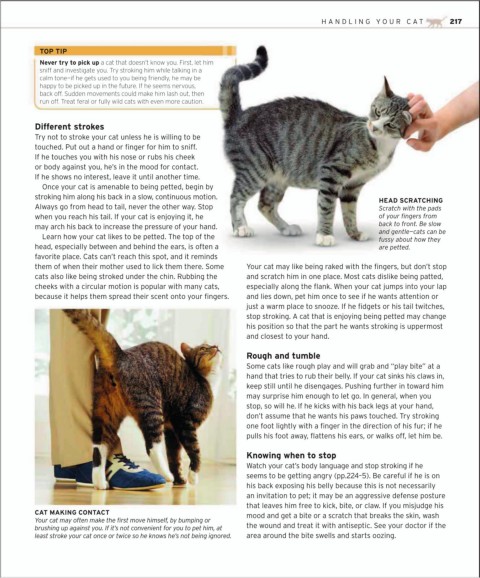
                                                                                        HEAD SCRATCHING
         Always go from head to tail, never the other way. Stop                         Scratch with the pads
         when you reach his tail. If your cat is enjoying it, he                        of your fingers from
                                                                                        back to front. Be slow
         may arch his back to increase the pressure of your hand.
                                                                                        and gentle—cats can be
           Learn how your cat likes to be petted. The top of the
                                                                                        fussy about how they
         head, especially between and behind the ears, is often a                       are petted.
         favorite place. Cats can’t reach this spot, and it reminds
         them of when their mother used to lick them there. Some   Your cat may like being raked with the fingers, but don’t stop
         cats also like being stroked under the chin. Rubbing the   and scratch him in one place. Most cats dislike being patted,
         cheeks with a circular motion is popular with many cats,   especially along the flank. When your cat jumps into your lap
         because it helps them spread their scent onto your fingers.   and lies down, pet him once to see if he wants attention or
                                                          just a warm place to snooze. If he fidgets or his tail twitches,
                                                          stop stroking. A cat that is enjoying being petted may change
                                                          his position so that the part he wants stroking is uppermost
                                                          and closest to your hand.

                                                          Rough and tumble
                                                          Some cats like rough play and will grab and “play bite” at a
                                                          hand that tries to rub their belly. If your cat sinks his claws in,
                                                          keep still until he disengages. Pushing further in toward him
                                                          may surprise him enough to let go. In general, when you
                                                          stop, so will he. If he kicks with his back legs at your hand,
                                                          don’t assume that he wants his paws touched. Try stroking
                                                          one foot lightly with a finger in the direction of his fur; if he
                                                          pulls his foot away, flattens his ears, or walks off, let him be.

                                                          Knowing when to stop
                                                          Watch your cat’s body language and stop stroking if he
                                                          seems to be getting angry (pp.224–5). Be careful if he is on
                                                          his back exposing his belly because this is not necessarily
                                                          an invitation to pet; it may be an aggressive defense posture
                                                          that leaves him free to kick, bite, or claw. If you misjudge his
         CAT MAKING CONTACT                               mood and get a bite or a scratch that breaks the skin, wash
         Your cat may often make the first move himself, by bumping or
         brushing up against you. If it’s not convenient for you to pet him, at   the wound and treat it with antiseptic. See your doctor if the
         least stroke your cat once or twice so he knows he’s not being ignored.  area around the bite swells and starts oozing.

