


Page 217 - The Complete Cat Breed Book (DK)
P. 217
F OOD AND FEEDING           215


         Special diets
         Your cat’s dietary needs will change throughout his life.
         Kittens need lots of protein, fat, and calories to support their
         rapid growth. Use specially formulated kitten food to avoid
         deficiencies that could cause problems later in life. For the
         first week after bringing your kitten home, give him the
         same food that he has eaten since weaning. To introduce
         a new food, replace 10 percent of the original food with the
         new food, increasing the proportion by 10 percent daily
         until your kitten is eating only the new food by the tenth
         day—this will prevent diarrhea. If he does get an upset
         stomach, revert to a higher proportion of the old food and
         take longer to make the switchover.
           A pregnant cat needs extra protein and vitamins, and will
         want to eat more in the final stages of pregnancy. This may
         mean giving her smaller meals more frequently if she cannot
         eat as much as usual at a time. She will also have increased
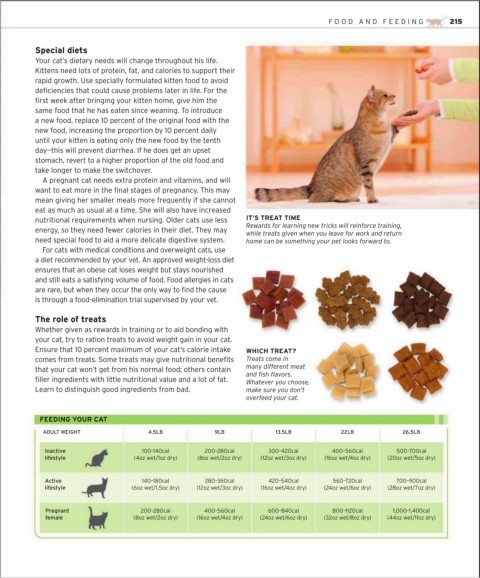
         nutritional requirements when nursing. Older cats use less   IT’S TREAT TIME
                                                          Rewards for learning new tricks will reinforce training,
         energy, so they need fewer calories in their diet. They may
                                                          while treats given when you leave for work and return
         need special food to aid a more delicate digestive system.   home can be something your pet looks forward to.
           For cats with medical conditions and overweight cats, use
         a diet recommended by your vet. An approved weight-loss diet
         ensures that an obese cat loses weight but stays nourished
         and still eats a satisfying volume of food. Food allergies in cats
         are rare, but when they occur the only way to find the cause
         is through a food-elimination trial supervised by your vet.

         The role of treats
         Whether given as rewards in training or to aid bonding with
         your cat, try to ration treats to avoid weight gain in your cat.
         Ensure that 10 percent maximum of your cat’s calorie intake   WHICH TREAT?
         comes from treats. Some treats may give nutritional benefits   Treats come in
                                                          many different meat
         that your cat won’t get from his normal food; others contain
                                                          and fish flavors.
         filler ingredients with little nutritional value and a lot of fat.
                                                          Whatever you choose,
         Learn to distinguish good ingredients from bad.   make sure you don’t
                                                          overfeed your cat.
          FEEDING YOUR CAT
           ADULT WEIGHT            4.5LB          9LB           13.5LB          22LB          26.5LB

                                  100–140cal    200–280cal     300–420cal     400–560cal    500–700cal
           Inactive
                                (4oz wet/1oz dry)  (8oz wet/2oz dry)  (12oz wet/3oz dry)  (16oz wet/4oz dry)  (20oz wet/5oz dry)
           lifestyle
                                  140–180cal    280–360cal     420–540cal     560–720cal    700–900cal
           Active
                               (6oz wet/1.5oz dry)  (12oz wet/3oz dry)  (16oz wet/4oz dry)  (24oz wet/6oz dry)  (28oz wet/7oz dry)
           lifestyle
                                 200–280cal     400–560cal     600–840cal     800–1120cal   1,000–1,400cal
           Pregnant
                                (8oz wet/2oz dry)  (16oz wet/4oz dry)  (24oz wet/6oz dry)  (32oz wet/8oz dry)  (44oz wet/11oz dry)
           female

