


Page 218 - The Complete Cat Breed Book (DK)
P. 218
216      C ARE AND BEHA VIOR


        HANDLING YOUR CAT


        Cats are notoriously choosy about who they will allow to touch them,
        let alone pick them up and pet them. Some cats simply don’t like being
        picked up and will struggle to get free. There are right and wrong ways
        to handle a cat—learn how to do it properly and your cat will enjoy the
        opportunity to get closer to you. If he’s comfortable with being held, it
        will be easier for you to groom him and check for injury or illness.           A correctly held kitten


                                  STRESS-BUSTER          Start early
                                  There’s something about   The best time to get a cat used to being handled is when it is
                                  cats that makes us want to
                                  stroke them. Research has   a kitten. Early and routine contact from about two or three
                                  shown that petting cats is   weeks old helps kittens not only to develop faster but also
                                  good for reducing stress in   grow into more contented cats that are happy to be handled
                                  humans—and cats like it too.
                                                         by humans. If you have children, teach them to be gentle and
                                                         to treat the kitten with respect. Mistreated and mishandled
                                                         kittens will grow into nervous cats who keep their distance
                                                         from people and who are difficult to train. Cats have long
                                                         memories, and they will avoid children who handle them
                                                         too roughly or pull their tails.

                                                         How to pick up a cat
                                                         A very young kitten can be picked up by the scruff of his
                                                         neck, like his mother does, but he will need more support as
                                                         he gets older and heavier. When his mother stops picking him
                                                         up like this, so should you. From then on, the correct way to
                                                         pick up your cat will be to approach from the side and place
                                                         one hand flat against his ribcage, just behind his front legs.
                                                         Use the other hand to support him under his hindquarters.


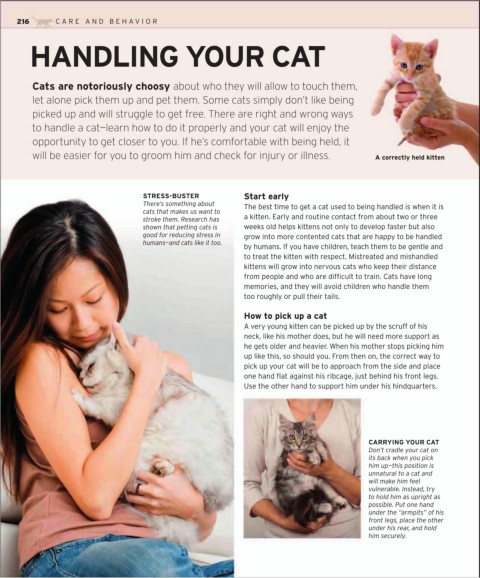
                                                                                      CARRYING YOUR CAT
                                                                                      Don’t cradle your cat on
                                                                                      its back when you pick
                                                                                      him up—this position is
                                                                                      unnatural to a cat and
                                                                                      will make him feel
                                                                                      vulnerable. Instead, try
                                                                                      to hold him as upright as
                                                                                      possible. Put one hand
                                                                                      under the “armpits” of his
                                                                                      front legs, place the other
                                                                                      under his rear, and hold
                                                                                      him securely.

