


Page 235 - The Complete Cat Breed Book (DK)
P. 235
TR AINING Y OUR C A T        233


                                                          Fun tricks
                                                          Once your cat has learned to come to you and to sit on
                                                          command, you can go on to teach him some tricks, such as
                                                          sitting up on his hindlegs, waving his paw, exchanging a
                                                          high-five, retrieving thrown cat toys, or even jumping
                                                          through a hoop. To get your cat to sit up, or beg, for
                                                          example, hold a treat above his head and when he rises give
                                                          the treat to him and say, “Good up.” To get your sitting cat to
                                                          high-five you, hold a teaser toy, such as feathers on the end
                                                          of a stick, in front of him. As he
                                                          raises his paw to the toy, say,
                                                          “Good high-five,” or “All right!”
                                                          and give him a reward. After
                                                          several lessons, use your hand
                                                          rather than the toy. Then
                                                          gradually phase out the treats
                                                          until you are just using clear hand
                                                          signals and verbal cues.
                                                           The same principles apply for teaching
                                                          tricks as they do for basic training: hold
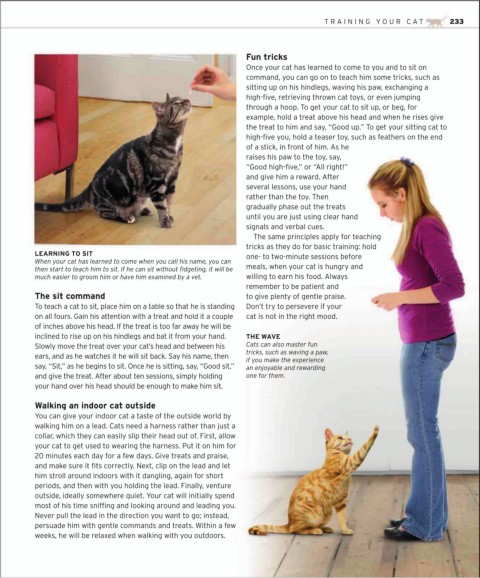
         LEARNING TO SIT                                  one- to two-minute sessions before
         When your cat has learned to come when you call his name, you can
         then start to teach him to sit. If he can sit without fidgeting, it will be   meals, when your cat is hungry and
         much easier to groom him or have him examined by a vet.  willing to earn his food. Always
                                                          remember to be patient and
         The sit command                                  to give plenty of gentle praise.
         To teach a cat to sit, place him on a table so that he is standing   Don’t try to persevere if your
         on all fours. Gain his attention with a treat and hold it a couple   cat is not in the right mood.
         of inches above his head. If the treat is too far away he will be
         inclined to rise up on his hindlegs and bat it from your hand.   THE WAVE
         Slowly move the treat over your cat’s head and between his   Cats can also master fun
                                                          tricks, such as waving a paw,
         ears, and as he watches it he will sit back. Say his name, then
                                                          if you make the experience
         say, “Sit,” as he begins to sit. Once he is sitting, say, “Good sit,”   an enjoyable and rewarding
         and give the treat. After about ten sessions, simply holding   one for them.
         your hand over his head should be enough to make him sit.
         Walking an indoor cat outside
         You can give your indoor cat a taste of the outside world by
         walking him on a lead. Cats need a harness rather than just a
         collar, which they can easily slip their head out of. First, allow
         your cat to get used to wearing the harness. Put it on him for
         20 minutes each day for a few days. Give treats and praise,
         and make sure it fits correctly. Next, clip on the lead and let
         him stroll around indoors with it dangling, again for short
         periods, and then with you holding the lead. Finally, venture
         outside, ideally somewhere quiet. Your cat will initially spend
         most of his time sniffing and looking around and leading you.
         Never pull the lead in the direction you want to go; instead,
         persuade him with gentle commands and treats. Within a few
         weeks, he will be relaxed when walking with you outdoors.

