


Page 25 - All About History - Issue 180-19
P. 25
Places To Explore

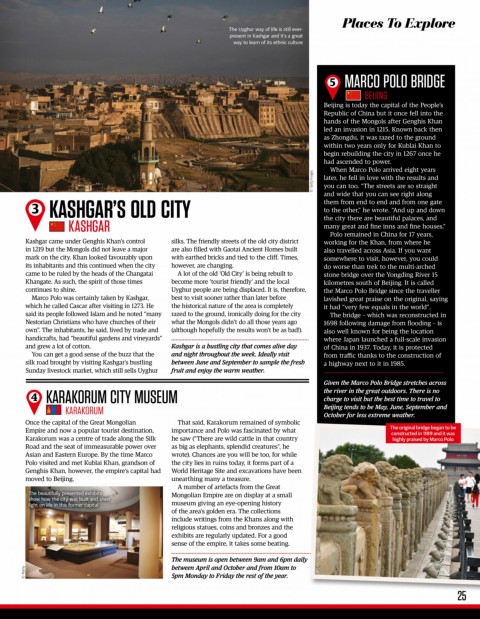
                                                                                      The Uyghur way of life is still ever-
                                                                                      present in Kashgar and it’s a great
                                                                                       way to learn of its ethnic culture


                                                                                                                           5     Marco Polo Bridge


                                                                                                                                        Beijing
                                                                                                                         Beijing is today the capital of the People’s
                                                                                                                         Republic of China but it once fell into the
                                                                                                                         hands of the Mongols after Genghis Khan
                                                                                                                         led an invasion in 1215. Known back then
                                                                                                                         as Zhongdu, it was razed to the ground
                                                                                                                         within two years only for Kublai Khan to
                                                                                                                         begin rebuilding the city in 1267 once he
                                                                                                                         had ascended to power.
                                                                                                                           When Marco Polo arrived eight years
                                                                                                                     GettyImages  later, he fell in love with the results and

                                                                                                                         you can too. “The streets are so straight
                                                                                                                     ©   and wide that you can see right along
             3     Kashgar’s old city                                                                                    them from end to end and from one gate
                                                                                                                         to the other,” he wrote. “And up and down
                          kashgar                                                                                        the city there are beautiful palaces, and
                                                                                                                         many great and fine inns and fine houses.”
                                                                                                                           Polo remained in China for 17 years,
          Kashgar came under Genghis Khan’s control             silks. The friendly streets of the old city district     working for the Khan, from where he
          in 1219 but the Mongols did not leave a major         are also filled with Gaotai Ancient Homes built          also travelled across Asia. If you want
          mark on the city. Khan looked favourably upon         with earthed bricks and tied to the cliff. Times,        somewhere to visit, however, you could
          its inhabitants and this continued when the city      however, are changing.                                   do worse than trek to the multi-arched
          came to be ruled by the heads of the Changatai           A lot of the old ‘Old City’ is being rebuilt to       stone bridge over the Yongding River 15
          Khangate. As such, the spirit of those times          become more ‘tourist friendly’ and the local             kilometres south of Beijing. It is called
          continues to shine.                                   Uyghur people are being displaced. It is, therefore,     the Marco Polo Bridge since the traveller
             Marco Polo was certainly taken by Kashgar,         best to visit sooner rather than later before            lavished great praise on the original, saying
          which he called Cascar after visiting in 1273. He     the historical nature of the area is completely          it had “very few equals in the world”.
          said its people followed Islam and he noted “many     razed to the ground, ironically doing for the city         The bridge – which was reconstructed in
          Nestorian Christians who have churches of their       what the Mongols didn’t do all those years ago           1698 following damage from flooding – is
          own”. The inhabitants, he said, lived by trade and    (although hopefully the results won’t be as bad!).       also well known for being the location
          handicrafts, had “beautiful gardens and vineyards”                                                             where Japan launched a full-scale invasion
          and grew a lot of cotton.                             Kashgar is a bustling city that comes alive day          of China in 1937. Today, it is protected
             You can get a good sense of the buzz that the      and night throughout the week. Ideally visit             from traffic thanks to the construction of
          silk road brought by visiting Kashgar’s bustling      between June and September to sample the fresh           a highway next to it in 1985.
          Sunday livestock market, which still sells Uyghur     fruit and enjoy the warm weather.

                                                                                                                         Given the Marco Polo Bridge stretches across
            4     karakoruM city MuseuM                                                                                  the river in the great outdoors. There is no
                                                                                                                         charge to visit but the best time to travel to
                         karakorum                                                                                       Beijing tends to be May, June, September and
                                                                                                                         October for less extreme weather.
          Once the capital of the Great Mongolian                  That said, Karakorum remained of symbolic
          Empire and now a popular tourist destination,          importance and Polo was fascinated by what                                       The original bridge began to be
                                                                                                                                                  constructed in 1189 and it was
          Karakorum was a centre of trade along the Silk         he saw (“There are wild cattle in that country                                    highly praised by Marco Polo
          Road and the seat of immeasurable power over           as big as elephants, splendid creatures”, he
          Asian and Eastern Europe. By the time Marco            wrote). Chances are you will be too, for while
          Polo visited and met Kublai Khan, grandson of          the city lies in ruins today, it forms part of a
          Genghis Khan, however, the empire’s capital had        World Heritage Site and excavations have been
          moved to Beijing.                                      unearthing many a treasure.
                                                                   A number of artefacts from the Great
           The beautifully presented exhibits                    Mongolian Empire are on display at a small
           show how the city was built and shed
           light on life in this former capital                  museum giving an eye-opening history
                                                                 of the area’s golden era. The collections
                                                                 include writings from the Khans along with
                                                                 religious statues, coins and bronzes and the
                                                                 exhibits are regularly updated. For a good
                                                                 sense of the empire, it takes some beating.


                                                                 The museum is open between 9am and 6pm daily          ©  Getty Images
          ©  Alamy                                               between April and October and from 10am to
                                                                 5pm Monday to Friday the rest of the year.

