


Page 23 - All About History - Issue 180-19
P. 23
Q&A With...


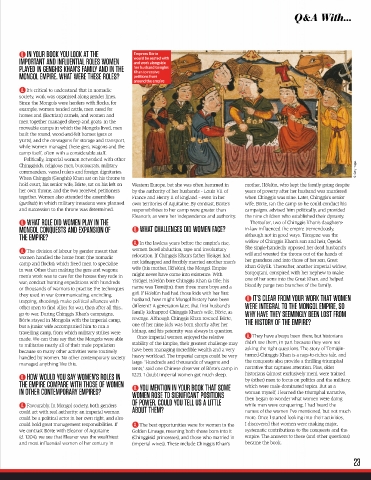
           Q. in yoUr book yoU look at the                       Empress Börte
          important and inflUential roles Women                  would be seated with
                                                                 and work alongside
          played in genghis khan’s family and in the             her husband Genghis
                                                                 Khan to receive
          mongol empire. What Were these roles?                  petitions from
                                                                 around the empire

           a.  It’s critical to understand that in nomadic
          society, work was organised along gender lines.
          Since the Mongols were herders with flocks, for
          example, women tended cattle, men cared for
          horses and (Bactrian) camels, and women and
          men together managed sheep and goats. In the
          moveable camps in which the Mongols lived, men
          built the round, wood-and-felt homes (gers or
          yurts), and the ox-wagons for storage and transport,
          while women managed these gers, wagons and the
          camp itself, often with a considerable staff.
             Politically, imperial women networked with other
          Chinggisids, religious men, bureaucrats, military
          commanders, vassal rulers and foreign dignitaries.                                                                                                                ©  Getty Images
          When Chinggis (Genghis) Khan sat on his throne to
          hold court, his senior wife, Börte, sat on his left on  Western Europe, but she was often hemmed in         mother, Hö’elün, who kept the family going despite
          her own throne, and the two received petitioners      by the authority of her husbands – Louis VII of       years of poverty after her husband was murdered
          together. Women also attended the assemblies          France and Henry II of England – even in her          when Chinggis was nine. Later, Chinggis’s senior
          (quriltais) in which military invasions were planned  own territories of Aquitaine. By contrast, Börte’s    wife, Börte, ran the camp so he could conduct his
          and succession to the throne was determined.          responsibilities to her camp were greater than        campaigns, advised him politically, and provided
                                                                Eleanor’s, as were her independence and authority.    the nine children who established their dynasty.
           Q. What role did Women play in the                                                                            Thereafter, two of Chinggis Khan’s daughters-
          mongol ConQUests and expansion of                      Q. What Challenges did Women faCe?                   in-law influenced the empire tremendously,

          the empire?                                                                                                 although not in good ways. Töregene was the
                                                                 a. In the lawless years before the empire’s rise,    widow of Chinggis Khan’s son and heir, Ögedei.
           a. The division of labour by gender meant that       women faced abduction, rape and involuntary           She single-handedly opposed her dead husband’s
                                                                                                                      will and wrested the throne out of the hands of
          women handled the home front (the nomadic             reIocation. If Chinggis Khan’s father Yisügei had     her grandson and into those of her son, Great
          camp and flocks), which freed men to specialise       not kidnapped and forcibly married another man’s      Khan Güyük. Thereafter, another imperial widow,
          in war. Other than making the gers and wagons,        wife (his mother, Hö‘elün), the Mongol Empire         Sorqoqtani, conspired with her nephew to make
          men’s work was to care for the horses they rode in    might never have come into existence. With            one of her sons into the Great Khan, and helped
          war; conduct hunting expeditions with hundreds        Yisügei, Hö‘elün bore Chinggis Khan (a title; his     bloodily purge two branches of the family.
          or thousands of warriors to practise the techniques   name was Temüjin), then three more boys and a
          they used in war (communicating, encircling,          girl. If Hö’elün had had those kids with her first     Q. it’s Clear from yoUr Work that Women
          trapping, shooting); make political alliances with    husband, how might Mongol history have been
          other men to find allies for war, then after all this…  different? A generation later, that first husband’s  Were integral to the mongol empire, so
          go to war. During Chinggis Khan’s campaigns,          family kidnapped Chinggis Khan’s wife, Börte, as      Why have they seemingly been lost from
          Börte stayed in Mongolia with the imperial camp,      revenge. Although Chinggis Khan rescued Börte,        the history of the empire?
          but a junior wife accompanied him to run a            one of her nine kids was born shortly after her
          travelling camp, from which military strikes were     kidnap, and his paternity was always in question.
          made. We can thus say that the Mongols were able         Once imperial women enjoyed the relative            a.  They have always been there, but historians
          to militarise nearly all of their male population     stability of the Empire, their greatest challenge may  didn’t see them, in part because they were not
          because so many other activities were routinely       have been managing incredible wealth and a very       asking the right questions. The story of Temüjin-
          handled by women. No other contemporary society       heavy workload. The imperial camps could be very      turned-Chinggis Khan is a rags-to-riches tale, and
          managed anything like this.                           large: “Hundreds and thousands of wagons and          the conquests also provide a thrilling triumphal
                                                                tents,” said one Chinese observer of Börte’s camp in  narrative that captures attention. Plus, older
           Q. hoW WoUld yoU say Women’s roles in                1223. I doubt imperial women got much sleep.          historians (almost exclusively men), were trained
                                                                                                                      by (other) men to focus on politics and the military,
          the empire Compare With those of Women                 Q. yoU mention in yoUr book that some                which were male-dominated topics. But as a
          in other Contemporary empires?                        Women rose to signifiCant positions                   woman myself, I learned the triumphal narrative,


                                                                                                                      while men were conquering. I had heard the
           a.  Favourably. In Mongol society, both genders      of poWer. CoUld yoU tell Us a little                  then began to wonder what women were doing
          could act with real authority: an imperial woman      aboUt them?                                           names of the women I’ve mentioned, but not much
          could be a political actor in her own right, and also                                                       more. Once I started looking into their activities,
          could hold great management responsibilities. If       a.  The best opportunities were for women in the     I discovered that women were making major,
          we contrast Börte with Eleanor of Aquitaine           Golden Lineage, meaning both those born into it       systematic contributions to the conquests and the
          (d. 1204), we see that Eleanor was the wealthiest     (Chinggisid princesses), and those who married in     empire. The answers to these (and other questions)
          and most influential women of her century in          (imperial wives). These include Chinggis Khan’s       became the book.


                                                                                                                                                                           23

