


Page 58 - All About History - Issue 180-19
P. 58
case of Akhenaten the facts do not bear the
          construction often put on them.”                          “The Tell el Amarna period has had more nonsense written
             So many theories abound about this king due to
          the lack of tangible archaeological evidence about               about it than any other period in Egyptian history”
          his reign and we can thank the ancient Egyptians
          themselves for this fragmentary survival rate.
          Following his reign, Akhenaten’s contemporaries        the many things about the Amarna period               The Aten
          tried to erase his very existence from history. His    that is hotly debated. One prominent theory
          name was erased from the monuments and his             is that she was a cousin of Amenhotep IV.             There was nothing remarkable about Amenhotep
          temples, his city was razed to the ground and the      Her father is thought to be Ay, the brother           before he became king – nothing to suggest
          stones reused as building material.                    of queen Tiye and the king who followed               he would utterly reject traditional religion and
             So who was Akhenaten? Peaceful, religious           Tutankhamun onto the throne.                          culture. He grew up at Memphis and was raised
          activist or a heretic?                                    Together they had six children, all girls:         within the traditional religious culture that
             Akhenaten was the second son of Amenhotep           Meritaten, Meketaten, Ankhesenepaten (the             comprised a rich pantheon of gods. However,
          III and queen Tiye. He was born with the name          future wife of Tutankhamun), Neferneferuaten,         once he became king, Amenhotep IV (Akhenaten)
          Amenhotep, which he changed during the early           Neferneferure and Setepenre.                          abandoned all of these deities, replacing them
          years of his reign to Akhenaten, in honour of his         Nefertiti however was not the only wife of         with the Aten – the solar disc.
          newly revered god, the Aten.                           Akhenaten, and written evidence shows he had             The Aten, however, was not a new god. Aten
             As a second son, young Amenhotep was never          at least four wives: Nefertiti, Kiya (the mother of   was already part of the traditional Egyptian
          expected to be king, but between year 16 and 27 of     Tutankhamun), Tadukhipa, a Babylonian princess,       pantheon and was recorded as early as the twelfth
          his father’s reign, his older brother Thutmosis died   and his own daughter Ankhesenepaaten, who later       dynasty (1991 – 1782 BCE) in the Coffin Texts.
          leaving him as sole heir to the throne.                married Smenkhkare and Tutankhamun.                      Aten was traditionally depicted as a man with
             Just before Amenhotep IV, as he was crowned,           Akhenaten and Ankhesenepaaten also possibly        the head of a falcon surmounted by a sun disc,
          came to the throne he married an unknown               had a child together called Ankhesenepaaten           very similar to images of Re-Horakhty. Akhenaten
          woman named Nefertiti. Her parentage is one of         Tasherit (The Younger).                               abandoned this imagery and depicted the god as


            © Alamy


                                                                                                                                                                         © Getty Images


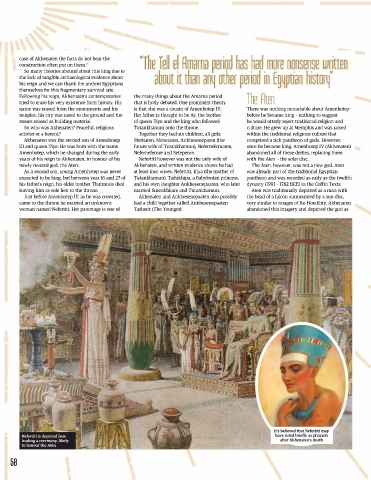
                                                                                                                                    It’s believed that Nefertiti may
           Nefertiti is depicted here                                                                                                have ruled briefly as pharaoh
           leading a ceremony, likely                                                                                                  after Akhenaten’s death
           to honour the Aten


      58

