


Page 61 - All About History - Issue 180-19
P. 61
The Heretic Pharaoh


          campaign against the cult of Amun. He began
          destroying temples and statues of Amun, including
          the name. Wherever the name of Amun appeared
          it was chiselled out, even from his own birth name
          Amenhotep and his father’s cartouches.

          Tell el Amarna


          The royal capital through Amenhotep III’s
          reign was at Memphis, in the north of Egypt,
          with the religious capital situated at Thebes.
          Memphis was associated with the creator god
          Ptah and Thebes was the seat of the king-of-the-
          gods Amun. Akhenaten would have been raised
          at one or both of these cities.
             Akhenaten decided in the early years of
          his reign to build a new capital dedicated to
          his favoured deity on a site that was untouched
          by any previous religious practice. He chose the
          barren site of Tell el Amarna in middle Egypt
          due to a dip in the cliffs, between which the
          sun rose, which resembled the hieroglyphic sign
          for ‘Horizon’. He called the city, Akhetaten – the
          Horizon of the Aten. The modern name for the site
          is Tell el Amarna and gives its name to this whole
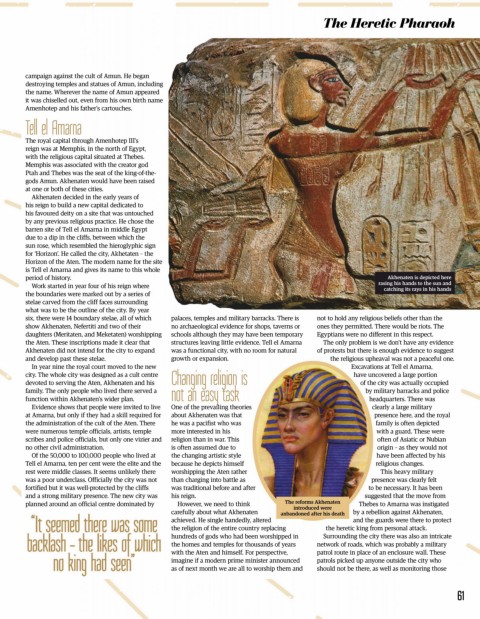
          period of history.                                                                                                                     Akhenaten is depicted here   © Alamy
             Work started in year four of his reign where                                                                                    rasing his hands to the sun and
                                                                                                                                               catching its rays in his hands
          the boundaries were marked out by a series of
          stelae carved from the cliff faces surrounding
          what was to be the outline of the city. By year
          six, there were 14 boundary stelae, all of which      palaces, temples and military barracks. There is       not to hold any religious beliefs other than the
          show Akhenaten, Nefertiti and two of their            no archaeological evidence for shops, taverns or       ones they permitted. There would be riots. The
          daughters (Meritaten, and Meketaten) worshipping      schools although they may have been temporary          Egyptians were no different in this respect.
          the Aten. These inscriptions made it clear that       structures leaving little evidence. Tell el Amarna       The only problem is we don’t have any evidence
          Akhenaten did not intend for the city to expand       was a functional city, with no room for natural        of protests but there is enough evidence to suggest
          and develop past these stelae.                        growth or expansion.                                       the religious upheaval was not a peaceful one.
             In year nine the royal court moved to the new                                                                         Excavations at Tell el Amarna,
          devoted to serving the Aten, Akhenaten and his changing religion is                                                       have uncovered a large portion
          city. The whole city was designed as a cult centre
                                                                                                                                       of the city was actually occupied
          family. The only people who lived there served a      not an easy task                                                         by military barracks and police
          function within Akhenaten’s wider plan.                                                                                         headquarters. There was
             Evidence shows that people were invited to live    One of the prevailing theories                                             clearly a large military
          at Amarna, but only if they had a skill required for  about Akhenaten was that                                                    presence here, and the royal
          the administration of the cult of the Aten. There     he was a pacifist who was                                                   family is often depicted
          were numerous temple officials, artists, temple       more interested in his                                                       with a guard. These were
          scribes and police officials, but only one vizier and  religion than in war. This                                                  often of Asiatic or Nubian
          no other civil administration.                        is often assumed due to                                                      origin – as they would not
             Of the 50,000 to 100,000 people who lived at       the changing artistic style                                                  have been affected by his
          Tell el Amarna, ten per cent were the elite and the   because he depicts himself                                                  religious changes.
          rest were middle classes. It seems unlikely there     worshipping the Aten rather                                                   This heavy military
          was a poor underclass. Officially the city was not    than charging into battle as                                               presence was clearly felt
          fortified but it was well-protected by the cliffs     was traditional before and after                                          to be necessary. It has been
          and a strong military presence. The new city was      his reign.                                                              suggested that the move from
          planned around an official centre dominated by           However, we need to think               The reforms Akhenaten      Thebes to Amarna was instigated
                                                                                                              introduced were
                                                                carefully about what Akhenaten           anbandoned after his death  by a rebellion against Akhenaten,
            “it seemed there was some                           achieved. He single handedly, altered                     the heretic king from personal attack.
                                                                                                                                    and the guards were there to protect
                                                                the religion of the entire country replacing
           backlash – the likes of which                        hundreds of gods who had been worshipped in            network of roads, which was probably a military
                                                                                                                         Surrounding the city there was also an intricate
                                                                the homes and temples for thousands of years

                     no king had seen”                          with the Aten and himself. For perspective,            patrol route in place of an enclosure wall. These
                                                                imagine if a modern prime minister announced
                                                                                                                       patrols picked up anyone outside the city who
                                                                                                                       should not be there, as well as monitoring those
                                                                as of next month we are all to worship them and


                                                                                                                                                                           61

