


Page 62 - All About History - Issue 180-19
P. 62
who were leaving. So was this apparent fear                It was worse than those things Nebmaatra
                                                                justified or was Akhenaten paranoid?                                 Amenhotep III heard
                                                                   To answer this we have to turn to an                         … It was worse than those things
                                                                extraordinary part of the inscription on one                 Menkheperure Thutmosis III heard
                                                                of the boundary stelae that marked the boundaries           And it was worse than those things heard
                        WHo WAs                                 of Tell el Amarna. Amidst the hyperbole about           by any kings who had ever assumed the white

                                                                                                                             Crown (ie ruled the south of Egypt).”
                                                                why Amarna was chosen as the city to the Aten,
                                                                it states,
                                                                                                                         It is clear the motivation to move the capital
                      smEnkArA?                                      “It was worse than those things I heard in        city from Thebes to Tell el Amarna was more
                                                                                   regnal year 4
                                                                                                                       than religious inspiration. It seemed there was
                                                                      It was worse than those things I heard in
                                                                                                                       some backlash – the likes of which no king had
                                                                                  regnal year 3,
                 Was the shadowy co-ruler of                          It was worse than those things I heard in        seen. What this backlash was, however, will
                                                                                                                       remain a mystery. It is possible it was a potential
              Akhenaten really Nefertiti taking                                    regnal year 2                       challenge to wrest the throne from him, or there
                       on the role of king?                           It was worse than those things I heard in        had been audible criticism to his religious changes.

                                                                                   regnal year 1                       Whatever it was, it was disturbing enough for
             One of the most popular theories is that
             Smenkhare was in fact Nefertiti. This
             is based on nomenclature – essentially
             following Nefertiti’s name changes. In year
             12 of Akhenaten’s reign Nefertiti disappears
             from the records as the Great Royal Wife,
             Nefernefruaten-Nefertiti. This led some
             scholars to believe she had fallen from grace
             and had been banished from Tell el Amarna.
               However in year 13, a co-ruler appears
             called Ankhkheperure-Nefernefruaten, with
             the title of Great Royal Wife being
             transferred to Akhenaten’s
             oldest daughter Meritaten.
             Further evidence that
             this co-ruling king was
             Nefertiti was found in
             the form of bezel-rings
             bearing the feminine
             form of the name,
             Ankh-et-kheperure
             rather than the masculine
             Ankhkheperure.
               Then another figure
             appears as co-ruler,
             known as Ankhkheperure-
             Smenkhare, who was
             co-ruler for two to
             three years before
             Akhenaten died, and then
             ruled alone, dying a few
             months later. He was also
             married to Meritaten as his
             Great Royal Wife, although
             it is thought she predeceased
             him. He then married the only
             surviving daughter of Akhenaten,
             Ankhesenepaaten, who had already
             been married to her father and
             bore him a child.
               Upon the death of
             Smenkhare, the throne
             passed to Tutankhamun
             who married
             Smenkhare’s widow
          © Getty Images  Ankhesenpaaten.                                                                                                             depicted handing out   © Alamy
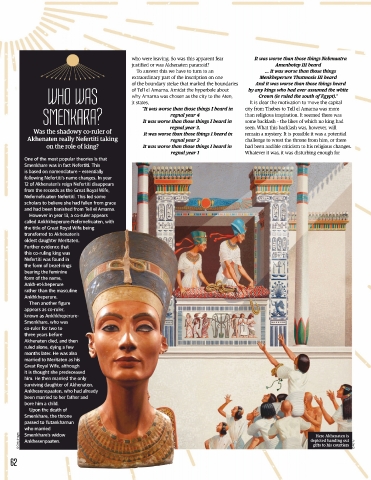
                                                                                                                                                        Here Akhenaten is
                                                                                                                                                       gifts to his courtiers


      62

