


Page 63 - All About History - Issue 180-19
P. 63
The Heretic Pharaoh


          Akhenaten to record this on the stelae for eternity,  and the poor condition of the tomb had
          and surround himself with the military in his new     damaged the burial even further.
          city with the carefully chosen inhabitants.              Many of the funerary goods in KV55
                                                                originally had belonged to a woman but
          rebellion                                             had altered by the addition of a uraeus

                                                                to the canopics and coffins, making
          So did the Egyptian population change its             them suitable for a king. These were later
          religious fidelities on the behest of the king?       removed when the tomb was ransacked
          The short answer is ‘no’.                             and the names on the equipment were
             People, certainly paid lip service to the new      also hacked out and the gold removed
          religion, probably out of self-preservation but       from the coffin.
          in their own homes they maintained their                 Akhenaten, the peaceful, monotheist had
          traditional religious practices.                      clearly made enemies throughout his short
             Evidence from all over Egypt, and even at          reign who believed his crimes were enough
          Tell el Amarna, shows that the general population     to justify the destruction of his funerary
          were still worshipping household gods such as         assemblage that would eliminate any
          Bes, the dwarf god, Taweret, the pregnant hippo,      chance of him having an afterlife.
          and state goddess Hathor. These deities were
          worshipped quite openly, and in some of the
          houses at Tell el Amarna, images of the god Bes          “such public
          were painted onto the walls.
             Further signs that Akhenaten’s religion was
          losing traction, even at his religious city can be       lip service to
          seen in the naming of his two youngest daughters.
          Despite these girls being born when the Aten            the religion of
          was the primary deity, and their father was equal
          status to the god they had names dedicated to             Akhenaten,
          Ra/Re and not the Aten.
             Such public lip service to the religion
          of Akhenaten, made it all the easier for                   made it all
          Tutankhamun to revert back to the traditional
          pantheon once he became king following the              the easier for
          death of Akhenaten and Smenkhare.
             Tutankhamun was born as Tutankhaten, so the
          first thing he did when he came to throne at aged     Tutankhamun to
          eight or nine was to change his name to honour
          Amun. He then moved the capital city back to            revert back to
          Thebes, and re-established the cult of Amun.
             As one would expect, once the king, royal            the traditional
          court and power moved away from Tell el
          Amarna, everyone else also drifted away and
          moved back to their home villages and towns.               pantheon”
          Life then pretty much carried on as normal for
          the people of Egypt.
             Akhenaten died in 1334 BCE and evidence
          suggests he was buried in the royal tomb in Tell
          el Amarna. However it seems unlikely that this
          was his final resting place, and Petrie discovered
          broken fragments of his sarcophagus, canopic jars
          and shabti figures around the city. He was clearly
          considered a public enemy after death and his
          burial was in danger of reprisal.
             It is thought that Tutankhamun may have
          brought his father’s body to the Valley of the
          Kings in Thebes in order to prevent the body
          being defiled by his enemies. For many years the
          body in KV55 was thought to be the body of the
          re-interred Akhenaten, and this was proven to
          be the case through DNA testing. Tutankhamun
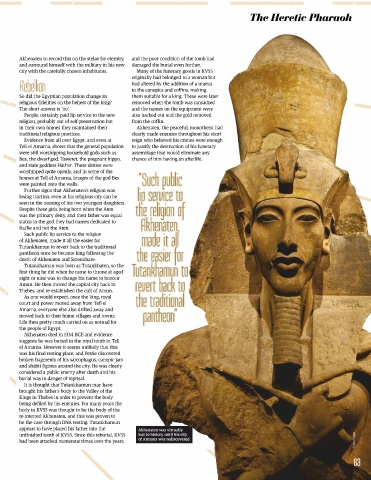
          appears to have placed his father into the               Akhenaten was virtually
          unfinished tomb of KV55. Since this reburial, KV55       lost to history until his city
          had been attacked numerous times over the years,         of Armana was rediscovered                                                                              © Getty Images


                                                                                                                                                                           63

