


Page 69 - All About History - Issue 180-19
P. 69
Women Of Apollo


                                                                           NASA’S

          and so people could watch me. In earlier missions,
          I received obscene phone calls and I never knew                UNSUNG
          where they came from. After the third time, I did                                                              ELEANOR ‘ELLIE’
          report it to a man who saw the look on my face                 HEROES                                          FORAKER
          and saw me slam the phone down, and I concluded
          that he must have taken action because those calls                                                             Foraker and her team of seamstresses
                                                                              The women whose
          stopped. I just tried to stay focused on getting my                                                            were responsible for sewing the A7L Apollo
          job done and that was what really buoyed me.                   contribution to Apollo has                      spacesuits, a high-pressured task where the
                                                                          been forgotten by history                      smallest mistake could have proven fatal for
          What was the atmosphere like in the                                                                            the astronauts.
          firing room during the launch?
          Things are fairly quiet in the firing room, the noise     SUSAN                                                KATHERINE
          dampens down and you’re listening. There is               FINLEY                                               JOHNSON
          nobody pushing a button to go, it was an automatic,
          final countdown. In Florida, we did not have              The longest-serving woman to have                    As one of the mathematicians and ‘human
          that same ‘go’ system as mission control, so our          worked at NASA, Finley built the Deep                computers’ based at Langley, Johnson’s work
          whole strategy was that you only said something           Space Network, which transmitted                     was critical to the mission’s success as she
          if you needed to cut off the launch. There were a         Armstrong’s historic words from the Moon             helped to calculate Apollo 11’s trajectory to
          thousand people listening who could make that             across the world.                                    the Moon.
          request, but we all wanted to go and if there’s no
          reason, you’re not going to call for a cut off.
                                                                    DOROTHY                                              MARY
          Where were you when Apollo 11                             VAUGHAN                                              JACKSON
          successfully landed on the Moon?                          Vaughan was another one of the ‘human                The first black female engineer at NASA,
          The firing room in Florida is not needed at landing       computers’ and the first black supervisor            Jackson was ‘human computer’ alongside
          and so most of the launch team were getting a             at Langley, helping to calculate the flight          Johnson and Vaughan, calculating flight
          little bit of a break and I was actually on vacation.     trajectory that landed man on the Moon.              trajectories at Langley.
          Like everybody else on planet Earth I watched
          the landing on TV. My husband said, “Jo, you’re
          going to be in the history books someday,” and            JUDITH                                               DOROTHY
          that’s the first time I really thought about it from
          the perspective of history. I knew from a scientific      LOVE COHEN                                           ‘DOTTIE’ LEE
          standpoint, because my personal hook in desiring          Cohen was an engineer who worked on                  As an engineer recruited straight from
          to work in the space program was the new                  the abort guidance system for the Apollo             college, Lee developed predictions for
          knowledge, and so the idea that it was going to be        programme, the same system that brought              Apollo’s re-entry to Earth and helped to
          so historic really hadn’t struck me until the landing     the astronauts of Apollo 13 home safely.             design the Command Module’s heat shield.
          and then boy, it just walloped me!

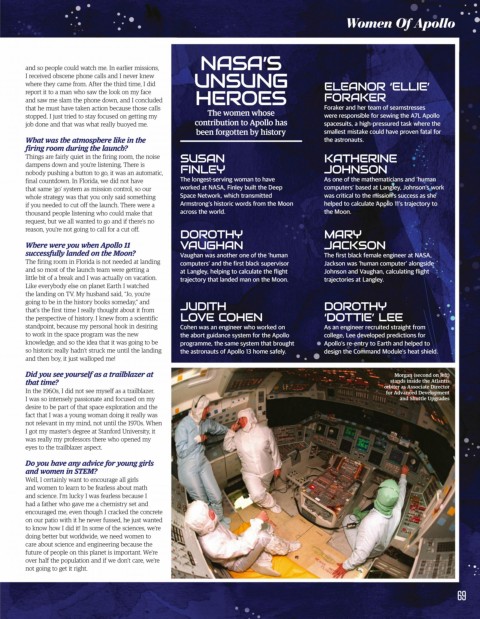
          Did you see yourself as a trailblazer at                                                                                                 Morgan (second on left)
          that time?                                                                                                                              stands inside the Atlantis
                                                                                                                                               orbiter as Associate Director
          In the 1960s, I did not see myself as a trailblazer.                                                                                  for Advanced Development
          I was so intensely passionate and focused on my                                                                                            and Shuttle Upgrades
          desire to be part of that space exploration and the
          fact that I was a young woman doing it really was
          not relevant in my mind, not until the 1970s. When
          I got my master’s degree at Stanford University, it
          was really my professors there who opened my
          eyes to the trailblazer aspect.

          Do you have any advice for young girls
          and women in STEM?
          Well, I certainly want to encourage all girls
          and women to learn to be fearless about math
          and science. I’m lucky I was fearless because I
          had a father who gave me a chemistry set and
          encouraged me, even though I cracked the concrete
          on our patio with it he never fussed, he just wanted
          to know how I did it! In some of the sciences, we’re
          doing better but worldwide, we need women to
          care about science and engineering because the
          future of people on this planet is important. We’re
          over half the population and if we don’t care, we’re
          not going to get it right.


                                                                                                                                                                           69

