


Page 67 - All About History - Issue 180-19
P. 67
Women Of Apollo


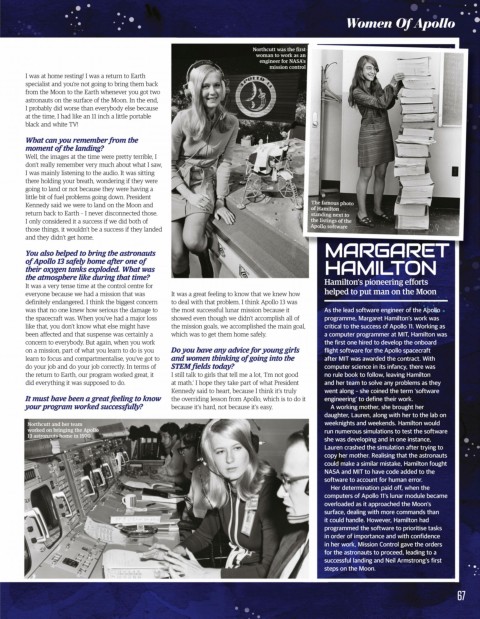
                                                                                               Northcutt was the first
                                                                                                woman to work as an
                                                                                                                 n
                                                                                                 engineer for NASA’s s
                                                                                                     mission contro ol
          I was at home resting! I was a return to Earth
          specialist and you’re not going to bring them back
          from the Moon to the Earth whenever you got two
          astronauts on the surface of the Moon. In the end,
          I probably did worse than everybody else because
          at the time, I had like an 11 inch a little portable
          black and white TV!


          What can you remember from the
          moment of the landing?
          Well, the images at the time were pretty terrible, I
          don’t really remember very much about what I saw,
          I was mainly listening to the audio. It was sitting
          there holding your breath, wondering if they were
          going to land or not because they were having a
          little bit of fuel problems going down. President
          Kennedy said we were to land on the Moon and                                                              The famous photo
                                                                                                                    of Hamilton
          return back to Earth – I never disconnected those.                                                        standing next to
          I only considered it a success if we did both of                                                          the listings of the
                                                                                                                    Apollo software
          those things, it wouldn’t be a success if they landed
          and they didn’t get home.
                                                                                                                         MARGARET

          You also helped to bring the astronauts
          of Apollo 13 safely home after one of                                                                          HAMILTON
          their oxygen tanks exploded. What was
          the atmosphere like during that time?
                                                                                                                         Hamilton’s pioneering efforts
          It was a very tense time at the control centre for
                                                                                                                         helped to put man on the Moon
          everyone because we had a mission that was            It was a great feeling to know that we knew how
          definitely endangered. I think the biggest concern    to deal with that problem. I think Apollo 13 was
          was that no one knew how serious the damage to        the most successful lunar mission because it             As the lead software engineer of the Apollo
          the spacecraft was. When you’ve had a major loss      showed even though we didn’t accomplish all of           programme, Margaret Hamilton’s work was
          like that, you don’t know what else might have        the mission goals, we accomplished the main goal,        critical to the success of Apollo 11. Working as
          been affected and that suspense was certainly a       which was to get them home safely.                       a computer programmer at MIT, Hamilton was
          concern to everybody. But again, when you work                                                                 the first one hired to develop the onboard
          on a mission, part of what you learn to do is you     Do you have any advice for young girls                   flight software for the Apollo spacecraft
          learn to focus and compartmentalise, you’ve got to    and women thinking of going into the                     after MIT was awarded the contract. With
          do your job and do your job correctly. In terms of    STEM fields today?                                       computer science in its infancy, there was
          the return to Earth, our program worked great, it     I still talk to girls that tell me a lot, ‘I’m not good   no rule book to follow, leaving Hamilton
          did everything it was supposed to do.                 at math.’ I hope they take part of what President        and her team to solve any problems as they
                                                                Kennedy said to heart, because I think it’s truly        went along – she coined the term ‘software
          It must have been a great feeling to know             the overriding lesson from Apollo, which is to do it     engineering’ to define their work.
          your program worked successfully?                     because it’s hard, not because it’s easy.                   A working mother, she brought her
                                                                                                                         daughter, Lauren, along with her to the lab on
           Northcutt and her team                                                                                        weeknights and weekends. Hamilton would
           worked on bringing the Apollo                                                                                 run numerous simulations to test the software
           13 astronauts home in 1970
                                                                                                                         she was developing and in one instance,
                                                                                                                         Lauren crashed the simulation after trying to
                                                                                                                         copy her mother. Realising that the astronauts
                                                                                                                         could make a similar mistake, Hamilton fought
                                                                                                                         NASA and MIT to have code added to the
                                                                                                                         software to account for human error.
                                                                                                                            Her determination paid off, when the
                                                                                                                         computers of Apollo 11’s lunar module became
                                                                                                                         overloaded as it approached the Moon’s
                                                                                                                         surface, dealing with more commands than
                                                                                                                         it could handle. However, Hamilton had
                                                                                                                         programmed the software to prioritise tasks
                                                                                                                         in order of importance and with confidence
                                                                                                                         in her work, Mission Control gave the orders
                                                                                                                         for the astronauts to proceed, leading to a
                                                                                                                         successful landing and Neil Armstrong’s first
                                                                                                                         steps on the Moon.


                                                                                                                                                                           67

