


Page 45 - (DK Eyewitness) Travel Guide - Southwest USA & National Parks
P. 45
INTRODUCING THE SOUTHWEST 43
THE HISTORY OF
THE SOUTHWEST
The Southwest is known for its landscape, dominated by desert, deep canyons,
and high mesas. Despite the arid conditions native civilizations have lived here
for thousands of years, adjusting to the arrival of other cultures – the Hispanic
colonizers of the 17th and 18th centuries and the Anglo-Americans of the 19th
and 20th. Its rich history has created a fascinating multicultural heritage.
Long before the appearance of the first people turned to roots and berries to
Spanish explorers in the 1500s, the supplement their diets. Anthropologists
Southwest was inhabited by a variety believe settled farming societies appeared
of native populations. Groups of hunters gradually as the population grew, and
walked here across the Bering Straits that new crops and farming techniques
over a land bridge that once joined Asia were introduced by migrants and traders
with North America; estimates of when from Mexico in around 800 BC, when corn
that occurred range from 15,000 to 35,000 first began to be cultivated in the region.
years ago. Descendants of these primitive Among the early farmers of the Southwest
hunter-gatherers, sometimes called Paleo- were the Basketmakers, named for their
Indians, gradually fanned out across the finely wrought baskets. Part of the Early
American continent as far south as present- Ancestral Puebloan, or Anasazi, culture,
day Argentina. The early inhabitants these people are thought to have lived
of the Southwest endured centuries of in extended family groups, in pithouse
hardship and adaptation to develop the dwellings. These were holes dug out of the
technology and skills required to survive earth up to 6 ft (2 m) deep, with roofs above
the rigors of life in this arid landscape. ground. The Basketmakers were efficient
hunters, using spears and domesticated
The First Inhabitants dogs. They kept turkeys, whose feathers
The first Native American peoples in the were highly valued as decoration.
Southwest region have been called the By around AD 500, agrarian society was
Clovis, named for the site in New Mexico well established in the Southwest and large
where stone spearheads were found villages, or pueblos, began to develop.
embedded in mammoth bones. This These usually centered around a large
hunter society roamed the area in small pithouse that was used for communal
groups between 10,000 and 8,000 BC. or religious use – the forerunner of the
Gradually, however, their prey of large ceremonial kiva, which is still very much
Pleistocene mammals died out, and tribal in use today (see p165).
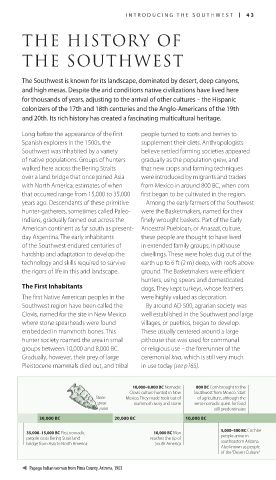
10,000–8,000 BC Nomadic 800 BC Corn brought to the
Clovis culture hunted in New Southwest from Mexico. Start
Stone Mexico. They made tools out of of agriculture, although the
spear mammoth ivory and stone semi-nomadic quest for food
point still predominates
30,000 BC 20,000 BC 10,000 BC
5,000–500 BC Cochise
35,000–15,000 BC First nomadic 10,000 BC Man
people cross Bering Strait land reaches the tip of people arrive in
bridge from Asia to North America South America southeastern Arizona.
Also known as people
of the “Desert Culture”
Papago Indian woman from Pima County, Arizona, 1903
042-047_EW_SW_USA.indd 43 17/01/2018 10:02

