


Page 46 - (DK Eyewitness) Travel Guide - Southwest USA & National Parks
P. 46
44 INTRODUCING THE SOUTHWEST THE HIST OR Y OF THE SOUTHWEST 45
Ancient Cultures Canada and Alaska. The Navajo moved Hopi Mesas and Acoma Pueblo
By AD 700 there were three main cultures in south between 1200 and 1400, while the
the Southwest: the Hoho kam, the Mogollon, Apache are thought to have arrived in The Hopi villages of Old Oraibi and Walpi, and
the Acoma Pueblo perch on high mesas in
and the Ancestral Puebloan. They had slowly the Southwest some time in the late northeastern Arizona and northern New Mexico.
developed, from around 200 and 300 BC, into 15th century. Dated to AD 1150, they are believed to be
America’s oldest continually occupied settlements.
soci eties based on settled commu nities and The Navajo were hunters who took to The Ancestral Puebloan forebears of the Hopi and
cultivated crops. Ancestral Puebloan people herding sheep brought by the Spanish. Acoma peoples arrived between AD 1100 and
began to build more elaborate dwellings There were four Apache groups: the 1300, a period known as the “Gathering of the
Clans.” The first to arrive was the Bear Clan, from
that grew into settlements such Jicarilla, the Mescalero, the Chiricahua, and Mesa Verde. Others came from Canyon de Chelly,
as Chaco Canyon (see the Western Apache, who continued their Chaco Canyon, the cliff dwellings of Keet Seel, and
pp178–9) in AD 800 nomadic lifestyle. The Apache were known Betatakin in the Navajo National Monument. Acoma pueblo, New Mexico (see p221)
and Mesa Verde (see as skillful warriors, especially the
pp184–5) in AD 1000. Chiricahua Apache of southern Arizona, tribal lands. Messages came back describing The Colony of New Mexico
These settlements whose leaders Cochise and Geronimo villages that Marcos identified as the Without gold, the Spanish lost interest until
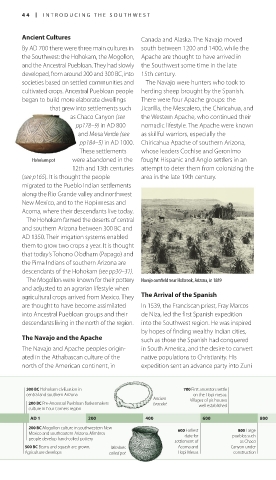
Hohokam pot were abandoned in the fought Hispanic and Anglo settlers in an fabled kingdom of gold, or Cibola. The Juan de Oñate’s 1598 expedition. Oñate
12th and 13th centuries attempt to deter them from coloni zing the priest never got there, but the myth of established the city of Santa Fe and the
(see p165). It is thought the people area in the late 19th century. riches persisted. colony of New Mexico, which included the
migrated to the Pueblo Indian settlements A year later, Francisco Vázquez de Coronado present-day states of New Mexico and
along the Rio Grande valley and northwest (see p220) returned with 330 soldiers, 1,000 Arizona and parts of Colorado, Utah,
New Mexico, and to the Hopi mesas and Indian allies, and more than 1,000 head of Nevada, and California.
Acoma, where their descendants live today. livestock. He overwhelmed the trading Spanish attempts to conquer the Indian
The Hohokam farmed the deserts of central center of Zuni Pueblo and spent two years pueblos led to bloody battles. Governor
and southern Arizona between 300 BC and traversing Arizona, New Mexico, Texas, and Oñate’s cruelty, the harsh conditions, and
AD 1350. Their irrigation systems enabled Kansas in search of Cibola. Coronado’s bad harvests caused many settlers to flee
them to grow two crops a year. It is thought brutal treatment of the Pueblo people,
that today’s Tohono O’odham (Papago) and sacking homes and burning villages, sowed
the Pima Indians of southern Arizona are the seeds for the Pueblo Revolt
descendants of the Hohokam (see pp30–31). 140 years later.
The Mogollon were known for their pottery Navajo cornfield near Holbrook, Arizona, in 1889
and adjusted to an agrarian lifestyle when
agricultural crops arrived from Mexico. They The Arrival of the Spanish
are thought to have become assimilated In 1539, the Franciscan priest, Fray Marcos
into Ancestral Puebloan groups and their de Niza, led the first Spanish expedition
descen dants living in the north of the region. into the Southwest region. He was inspired
by hopes of finding wealthy Indian cities,
The Navajo and the Apache such as those the Spanish had conquered
The Navajo and Apache peoples origin in South America, and the desire to convert
ated in the Athabascan culture of the native populations to Christianity. His
north of the American continent, in expedition sent an advance party into Zuni Engraving by Norman Price of Coronado setting out to discover a legendary kingdom of gold in 1540
300 BC Hohokam civilization in 700 First ancestors settle 1100–1300 “Gathering 1400 The Navajo and Apache migrate 1540–42 Francisco 1610 Don Pedro
central and southern Arizona on the Hopi mesas. of the Clans” on the from Canada to the Southwest Vázquez de de Peralta founds
Ancient Villages of pit houses Hopi mesas Coronado leads a the capital of
200 BC PreAncestral Puebloan Basketmakers bracelet well established 1300 Mesa Verde search for gold in Santa Fe
culture in Four Corners region deserted New Mexico
AD 1 200 400 600 800800 1000 1200 1400 1600
200 BC Mogollon culture in southwestern New 600 Earliest 800 Large 1020 Chaco c.1250 Ancient sites are 1539 Fray Marcos de Niza 1680 The
Mexico and southeastern Arizona. Mimbres date for pueblos such Canyon is at its mysteriously abandoned; heads first Spanish Pueblo Revolt
people develop handcoiled pottery height as a trading new pueblos established
settlement of as Chaco and cultural center along Rio Grande expedition to Southwest
500 BC Beans and squash are grown. Mimbres Acoma and Canyon under 1598 Juan de Oñate founds
Agriculture develops coiled pot Hopi Mesas construction Juan de Oñate permanent colony in New Mexico
042-047_EW_SW_USA.indd 44 28/11/17 12:35 PM 042-047_EW_SW_USA.indd 45 28/11/17 12:35 PM

