


Page 50 - (DK Eyewitness) Travel Guide - Southwest USA & National Parks
P. 50
48 INTRODUCING THE SOUTHWEST THE HIST OR Y OF THE SOUTHWEST 49
The Arrival of the Anglo-Americans Mining Boom Prospector
In the second half of the 1800s, the region was
a magnet for miners seeking their fortune. In
The first non-Spanish people of European descent, or Anglo- reality, few individuals profited, as large
Americans, to arrive in the Southwest were “mountain men” or fur companies swiftly gained control of the
trappers in the early 1800s. They learned survival skills from Native mining areas.
tribes, married Native women, and usually spoke more than one
Native language, and Spanish.
The opening of the Old Spanish Trail in 1776, and the forerunner to
the Santa Fe Trail from St. Louis in the East in 1792, made the region
accessible to traders and settlers (see pp28–9). Yet it was only after
Mexican independence was declared in 1821 that the territory Mountain Man
opened up to Anglo traders who brought luxury goods such as Jim Bridger was one of
many rugged individuals
oranges, silk handkerchiefs, and whisky. American soldiers arrived who opened up trade
in 1846, and by the 1850s the US government had taken the region routes to the west in
from the Mexicans. The Anglos, determined to subdue both Native the 1820s.
and Hispanic populations, wrested away their lands to make way The Coming of the Railroad
for vast ranches and towns such as In 1869, the transcontinental railroad
Tombstone, which grew around brought an influx of miners, adventurers,
the discovery of silver in 1877. and tourists to the Southwest, and saw new
industries emerge.
The Long Walk
Portrait of Navajo
leader, Manuelito
(1818–94) taken after
the Long Walk. More
than 8,000 Navajo
were sent to New
Mexico in 1864. Many
died on the way.
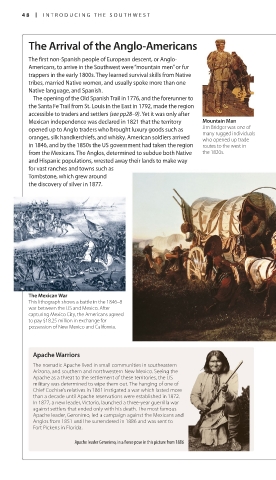
The Mexican War Wagon Trains on the Santa Fe Trail
This lithograph shows a battle in the 1846–8
war between the US and Mexico. After Charles Ferdinand Wimar’s The Attack on
capturing Mexico City, the Americans agreed the Emigrant Train (1856) depicts the
to pay $18.25 million in exchange for conflicts between the Apache and traders
possession of New Mexico and California. and settlers who poured into the Southwest
after the establishment of the Santa Fe Trail
(see pp28–9).
Apache Warriors Apache were often depicted
The nomadic Apache lived in small communities in southeastern attacking wagon trains. The
Arizona, and southern and northwestern New Mexico. Seeing the Apache, who had a fierce
Apache as a threat to the settlement of these territories, the US reputation, felt justifiably
military was determined to wipe them out. The hanging of one of threatened by Anglo settlers.
Chief Cochise’s relatives in 1861 instigated a war which lasted more
than a decade until Apache reservations were established in 1872.
In 1877, a new leader, Victorio, launched a three-year guerrilla war
against settlers that ended only with his death. The most famous Anglo-American Influence
Apache leader, Geronimo, led a campaign against the Mexicans and John Gast’s American Progress (1872)
Anglos from 1851 until he surrendered in 1886 and was sent to shows Indians pursued by a woman in
Fort Pickens in Florida.
a white robe – a symbol of American
culture. The schoolbook represents
Apache leader Geronimo, in a fierce pose in this picture from 1886 education; trains, ships, and settlers are
all signs of “civilization.”
048-049_EW_SW_USA.indd 48 28/11/17 12:39 PM 048-049_EW_SW_USA.indd 49 28/11/17 12:39 PM
Eyewitness Travel LAYERS PRINTED:
Feature template “UK” LAYER
(SourceReport v1.3)
Date 18th October 2012
Size 125mm x 217mm

