


Page 33 - All About History - Issue 54-17
P. 33
Why Blame the Kaiser?


                                                                     HOW THE REICH WAS RUN

                                                                     What was the kaiser’s role in German politics?

                                                                      T THE KAISER
                                                                      T The kaiser’s role was vague a
                                                                               role was vague and
                                                                      ambiguous, allowing Wilhelm to usually
                                                                      get his way. The kaiser alone had the
                                                                      power to interpret the constitution and,
                                                                      as head of the army, had control over
                                                                      foreign policy. He could declare martial
                                                                      law as well as dismiss or appoint the
                                                                      Reichstag and chancellor.

                                                                      MILITARY
                                                                      Article 63 of the constitution stated that
                                                                      the army was answerable to the emperor,
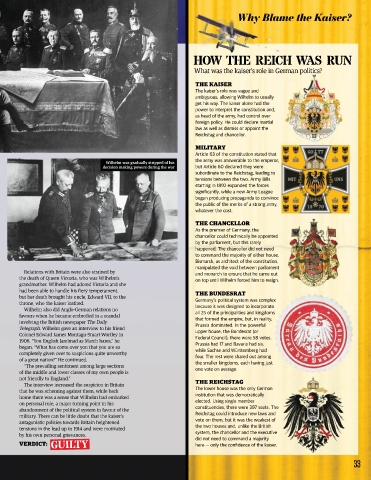
                                      Wilhelm was gradually stripped of his
                                     decision making powers during the war  but Article 60 declared they were
                                                                      subordinate to the Reichstag, leading to
                                                                      tensions between the two. Army Bills
                                                                      starting in 1892 expanded the forces
                                                                      significantly, while a new Army League
                                                                      began producing propaganda to convince
                                                                      the public of the merits of a strong army,
                                                                      whatever the cost.

                                                                      THE CHANCELLOR
                                                                      As the premier of Germany, the
                                                                      chancellor could technically be appointed
                                                                      by the parliament, but this rarely
                                                                      happened. The chancellor did not need
                                                                      to command the majority of either house.
                                                                      Bismarck, as architect of the constitution,
                                                                      manipulated the void between parliament
          Relations with Britain were also strained by                and monarch to ensure that he came out
        the death of Queen Victoria, who was Wilhelm’s                on top until Wilhelm forced him to resign.
        grandmother. Wilhelm had adored Victoria and she
        had been able to handle his fiery temperament,                THE BUNDESRAT
        but her death brought his uncle, Edward VII, to the           Germany’s political system was complex x
        throne, who the kaiser loathed.                               because it was designed to incorporate  e
          Wilhelm also did Anglo-German relations no                  all 25 of the principalities and kingdoms s
        favours when he became embroiled in a scandal                 that formed the empire, but, in reality,
        involving the British newspaper The Daily                     Prussia dominated. In the powerful
        Telegraph. Wilhelm gave an interview to his friend            upper house, the Bundesrat (or
        Colonel Edward James Montagu-Stuart-Wortley in                Federal Council), there were 58 votes.
        1908. “You English [are]mad as March hares,” he               Prussia had 17 and Bavaria had six,
        began. “What has come over you that you are so                while Sachse and Württemberg had
        completely given over to suspicions quite unworthy            four. The rest were shared out among
        of a great nation?” He continued.                             the smaller kingdoms, each having just
          “The prevailing sentiment among large sections              one vote on average.
        of the middle and lower classes of my own people is
        not friendly to England.”
          The interview increased the suspicion in Britain            THE REICHSTAG
        that he was scheming against them, while back                 The lower house was the only German
        home there was a sense that Wilhelm had embarked              institution that was democratically
        on personal rule, a major turning point in his                elected. Using single member
        abandonment of the political system in favour of the          constituencies, there were 397 seats. The
        military. There can be little doubt that the kaiser’s         Reichstag could introduce new laws and
        antagonistic policies towards Britain heightened              vote on them, but it was the weakest of
        tensions in the lead up to 1914 and were motivated            the two houses and, unlike the British
        by his own personal grievances.                               system, the chancellor and the executive
                                                                      did not need to command a majority
                   GUILTY
        VERDICT:                                                      here — only the confidence of the kaiser.
                                                                                                                             33

